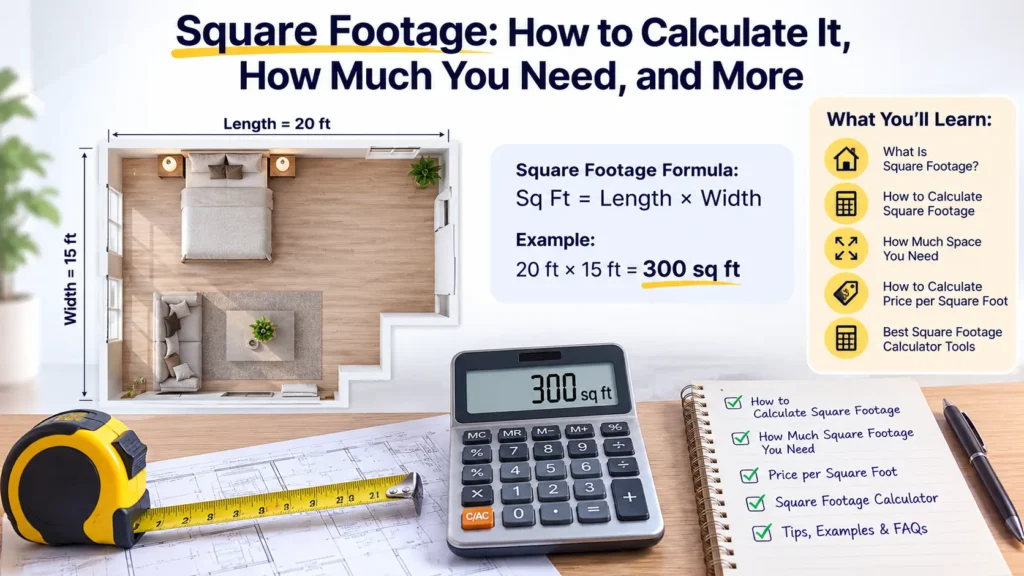
Knowing the square footage of a room, apartment, house, or other space is useful for much more than real estate listings. You may need it to buy flooring, estimate paint or renovation costs, compare properties, plan furniture, or simply understand how much usable space you have.
The good news is that the basic math is simple:
Length × Width = Square Footage
For example, a room that is 12 feet long and 10 feet wide has:
12 × 10 = 120 square feet
The difficult part comes when the space has an unusual shape, measurements in feet and inches, multiple rooms, cutouts, or different measurement conventions.
This guide explains how to calculate square footage accurately, how to calculate price per square foot, how to handle irregular rooms, how much space different needs may require, and when a professional measurement is worth considering.
What Is Square Footage?
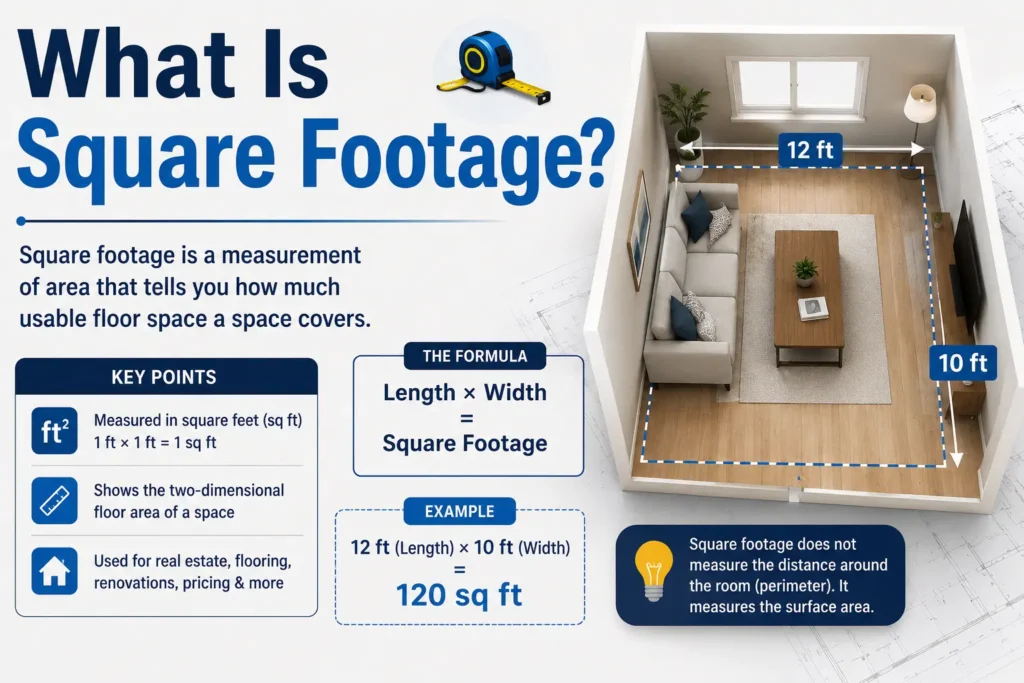
Square footage is a measurement of area expressed in square feet. It tells you how much two-dimensional floor space an area covers.
One square foot is a square measuring:
1 foot × 1 foot = 1 square foot
The term is commonly written as:
- sq ft
- sqft
- ft²
- square feet
For a rectangular room, the calculation is straightforward. You measure the length and width in feet and multiply them.
Square footage formula:
Length × Width = Area in square feet
A 15-foot by 12-foot room, for example, contains:
15 × 12 = 180 sq ft
Square footage measures area, not the distance around a room. That distinction matters when you’re estimating flooring, room size, or property area.
How to Calculate Square Footage
For a standard square or rectangular area, follow these steps.
1. Measure the Length
Measure one side of the space from end to end. Record the measurement in feet.
2. Measure the Width
Measure the side perpendicular to the length.
3. Multiply the Measurements
Use:
Length × Width = Square Footage
Example
Suppose your bedroom measures:
- Length: 14 ft
- Width: 11 ft
Calculation:
14 × 11 = 154 sq ft
So the bedroom has 154 square feet of floor area.
This basic method is also the foundation for calculating larger spaces. Current guides consistently use length multiplied by width as the starting point for square-foot measurements.
How to Calculate Square Footage of a Room
Calculating the square footage of a room is usually one of the easiest applications of the formula.
First, clear anything that prevents you from measuring accurately. A tape measure or laser distance meter can make the process easier.
For a rectangular room:
Room square footage = Length × Width
Example: 10 × 10 Room
A 10-foot by 10-foot room contains:
10 × 10 = 100 sq ft
Example: 12 × 15 Room
A 12-foot by 15-foot room contains:
12 × 15 = 180 sq ft
Example With Feet and Inches
Measurements do not always come out as whole feet.
Suppose a room is:
12 ft 6 in × 10 ft
Convert 6 inches into feet:
6 ÷ 12 = 0.5 ft
So the length is:
12.5 ft
Now calculate:
12.5 × 10 = 125 sq ft
The important rule is to put both measurements into the same unit before multiplying.
How to Calculate Square Footage of an Irregular or L-Shaped Room
Not every room is a perfect rectangle. You might have an L-shaped living room, an alcove, a bay window, or another unusual layout.
The easiest solution is to break the space into smaller, simple shapes.
Method 1: Add Multiple Rectangles
Imagine an L-shaped room made from two rectangles:
Section A: 12 ft × 10 ft
Section B: 6 ft × 5 ft
Calculate each section:
12 × 10 = 120 sq ft
6 × 5 = 30 sq ft
Then add them:
120 + 30 = 150 sq ft
The total is 150 square feet.
Method 2: Subtract a Missing Section
Another approach is to imagine the room as one large rectangle and subtract the missing corner.
For example:
Large rectangle:
16 × 12 = 192 sq ft
Missing corner:
5 × 4 = 20 sq ft
Final area:
192 − 20 = 172 sq ft
This approach can be easier when the irregular space naturally forms one large rectangle with a cutout. Similar methods are recommended by current square-footage guides for L-shaped and irregular rooms.
How to Calculate Square Footage for Multiple Rooms
When calculating an entire house or apartment, measure each room separately and then add the results.
For example:
| Area | Dimensions | Square Feet |
| Living room | 18 × 14 ft | 252 sq ft |
| Bedroom 1 | 12 × 11 ft | 132 sq ft |
| Bedroom 2 | 12 × 10 ft | 120 sq ft |
| Kitchen | 12 × 10 ft | 120 sq ft |
| Hallway | 15 × 4 ft | 60 sq ft |
Total:
252 + 132 + 120 + 120 + 60 = 684 sq ft
This room-by-room method is especially useful when the overall floor plan is not a simple rectangle.
A useful practice is to sketch the floor plan first and write each measurement directly on the drawing. This reduces the chance of forgetting an area or counting the same space twice.
How Do You Calculate Price Per Square Foot?
One of the most useful calculations related to square footage is price per square foot.
The formula is:
Price per square foot = Total Price ÷ Total Square Footage
Example
Suppose a property costs $360,000 and has 2,000 sq ft.
$360,000 ÷ 2,000 = $180 per sq ft
So the price is:
$180 per square foot
You can use the same concept for flooring, construction, painting, remodeling, landscaping, or other projects where the cost depends on area.
How Do You Calculate Square Footage Price?
If you already know the price per square foot and want to estimate the total cost, reverse the formula:
Total Cost = Square Footage × Price per Square Foot
For example:
1,200 sq ft × $8 = $9,600
That means a project priced at $8 per square foot would cost approximately $9,600 for 1,200 square feet before any additional charges.
Keep in mind that real project quotes can include labor, preparation, delivery, materials, taxes, minimum charges, or other costs that are not captured by a simple per-square-foot calculation.
How to Calculate Square Footage for Flooring
Flooring projects are a common reason people need an accurate sq ft measurement.
Start by calculating the area of every section that will receive flooring.
For a rectangular room:
Length × Width = Floor Area
If you have several rooms:
Room 1 + Room 2 + Room 3 = Total Flooring Area
You may also need additional material for cutting and installation. The exact amount depends on the flooring type, room layout, installation pattern, and manufacturer’s recommendations, so don’t assume that the material quantity must equal your exact measured area.
For a complex project, measure each section separately rather than estimating the entire floor as one shape.
How to Calculate Wall Square Footage
Square footage isn’t limited to floors. You can also calculate the area of a wall when estimating paint or some wall-covering materials.
The basic formula is:
Wall Length × Wall Height = Wall Area
For example:
15 ft × 8 ft = 120 sq ft
If there is a large door or window, you can calculate its area separately and subtract it when appropriate for your project estimate.
For instance, a 3 ft × 7 ft door covers:
3 × 7 = 21 sq ft
So:
120 − 21 = 99 sq ft
The exact estimating method can vary depending on the material and how the contractor or manufacturer calculates coverage.
How to Convert Square Feet to Square Meters
People in the US commonly use square feet, while square metres are widely used in the UK and other countries.
The approximate conversions are:
1 square foot = 0.0929 square meters
1 square meter = 10.764 square feet
Example
Suppose a room is 500 sq ft.
To convert it to square meters:
500 × 0.0929 = 46.45 m²
So 500 square feet is approximately 46.45 square meters.
When comparing property listings internationally, always check whether the listed area is in sq ft or m² before comparing numbers.
Square Footage vs. Usable Space
The number shown as a property’s square footage does not always represent every physical area you can see or access.
For example, a house may have a garage, unfinished basement, porch, attic, storage area, or other spaces that are treated differently depending on the purpose of the measurement.
This is particularly important when comparing real estate listings.
In the US, professional appraisal requirements can depend on the property type and measurement standard. Fannie Mae says appraisers must use ANSI Z765-2021 for measuring, calculating, and reporting gross living area and non-gross living areas for many applicable property types, with specific exceptions.
That means your personal floor-area calculation should not automatically be treated as the official square footage for a real estate appraisal, tax record, or legal purpose.
For an important property transaction, check the applicable local standards or use a qualified professional.
How Much Square Footage Do You Need?
There is no single square-foot number that works for everyone.
The amount of space you need depends on:
- Number of people in the household
- Number of bedrooms required
- Work-from-home needs
- Furniture size
- Storage requirements
- Entertaining habits
- Desired layout
- Budget
- Location
A smaller home can feel surprisingly spacious when the layout is efficient, while a larger home can feel cramped when the floor plan wastes space.
For a practical comparison, start with the space you currently have. Identify which rooms feel too small, which areas are rarely used, and which activities require more room. Then use that information when comparing homes or planning a renovation.
US Census data, for example, shows that the median floor area of new single-family homes completed in 2025 was 2,142 square feet, while the median for homes sold was 2,194 square feet. Those figures describe market data, not a recommended home size for an individual household.
How to Estimate Square Footage Without Exact Measurements
Sometimes you only need a rough estimate.
You can estimate an area by:
- Comparing it with a known room size.
- Using visible floor tiles as a reference.
- Measuring with a phone-based tool or laser device.
- Checking a floor plan or architectural drawing.
- Estimating separate sections rather than guessing the entire space at once.
These methods can help when you’re casually comparing spaces, but estimates should not replace precise measurements for expensive purchases, construction, legal documents, or property transactions.
Common Square Footage Calculation Mistakes
Even though the formula is simple, several mistakes can produce inaccurate results.
Mixing Feet and Inches
Don’t multiply “12 ft 6 in” as though it were 12.6 feet.
Convert the inches first.
Measuring Only One Section
An L-shaped or irregular space cannot always be calculated correctly with one length and one width.
Break it into smaller sections.
Double-Counting Areas
When combining multiple rectangles, make sure the sections do not overlap.
Confusing Area With Perimeter
Square footage measures the surface area. Perimeter measures the distance around the outside.
Assuming All Property Areas Are Equivalent
A personal floor measurement may not match an official real estate or appraisal measurement because the applicable rules can differ.
Use a Calculator Instead of Doing Every Calculation Manually
For quick calculations, an online calculator can reduce simple arithmetic errors, especially when you’re working through multiple measurements or price estimates.
Readers who want to turn these calculations into practical tasks can use Rapid Tool Plus for online calculator tools, percentage calculator functions, discount calculations, basic calculator, and other free online calculators. The Rapid Tool Plus calculator service can be useful when you need to check numbers quickly, while the wider platform also includes SEO tools, social media tools, creator tools, content creation tools, social media generators, and other online generators for related digital tasks.
A Simple Square Footage Calculation Checklist
Before you finalize your measurement, check:
1. Did you measure every relevant section?
2. Are all measurements in the same unit?
3. Did you multiply length by width correctly?
4. Did you divide irregular spaces into simpler shapes?
5. Did you avoid double-counting?
6. Are you calculating floor area, wall area, or another type of measurement?
7. Are you using the number for a personal estimate or an official purpose?
This quick review can catch many common errors before they affect your material order or project budget.
When Should You Hire a Professional?
DIY square footage calculation is perfectly practical for many everyday projects. A tape measure and a calculator are often enough for a rectangular room.
Professional help becomes more valuable when the measurement will be used for something important, such as:
- Property appraisal
- Major real estate transactions
- Building documentation
- Complex floor plans
- Legal or tax-related purposes
- Large renovation projects
If the financial consequences of being off by several square feet are significant, professional measurement may be worth the cost.
Final Takeaway
Calculating square footage usually starts with one simple formula:
Length × Width = Square Feet
For a basic rectangular room, that’s often all you need. For an L-shaped or irregular area, divide the space into smaller sections, calculate each section, and add or subtract the areas as necessary.
You can also use square footage to calculate price per square foot, estimate project costs, compare properties, plan flooring, and understand how much space you actually need.
The most important part is not complicated math. It is taking consistent measurements, using the correct units, avoiding double-counting, and understanding what type of square footage you’re actually trying to calculate.
Frequently Asked Questions
How do you calculate square footage?
Measure the length and width in feet, then multiply them:
Length × Width = Square Footage
A 12 ft × 10 ft room is 120 sq ft.
How do you calculate square footage of a room?
For a square or rectangular room, measure its length and width and multiply them. For an irregular room, divide it into smaller rectangles or other simple shapes and combine their areas.
How do you calculate price per square foot?
Divide the total price by the total square footage:
Price per Square Foot = Total Price ÷ Square Footage
For example, $300,000 ÷ 2,000 sq ft = $150 per sq ft.
How do you calculate square footage price?
Multiply the square footage by the price per square foot:
Square Footage × Price per Square Foot = Estimated Total Price
How many square feet do I need?
There is no universal answer. Your ideal square footage depends on household size, rooms, furniture, storage, lifestyle, layout, and budget.
Can I calculate square footage myself?
Yes. Basic rectangular spaces are easy to measure yourself. For complex properties or measurements used for important financial or legal purposes, consider checking applicable standards or hiring a qualified professional.