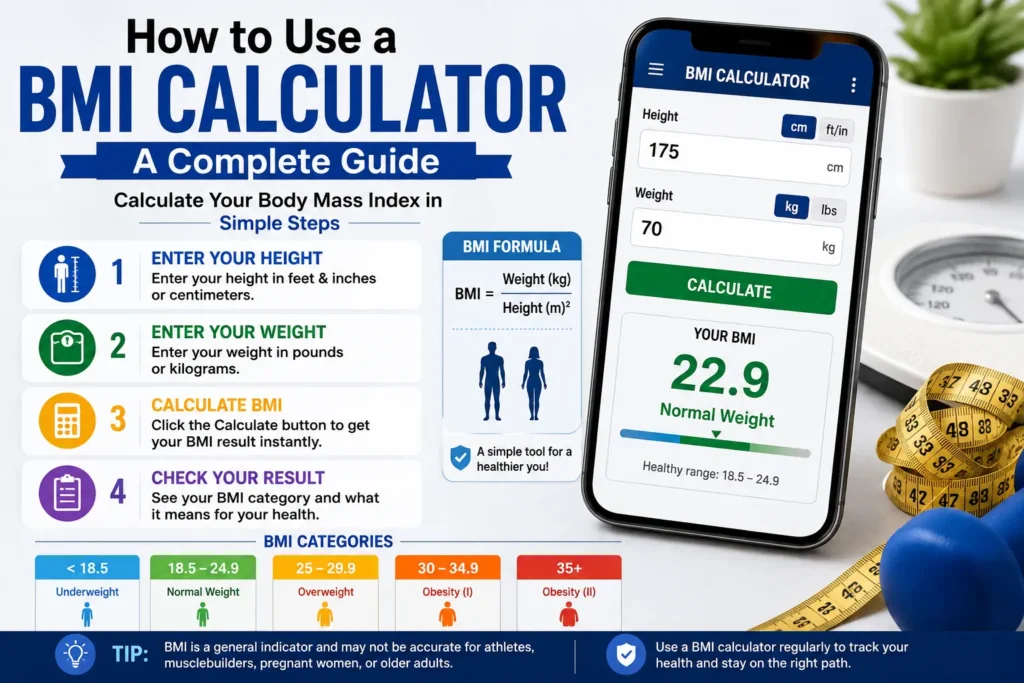
If you’ve typed “bmi calculator” into Google, you probably want one thing: a fast, accurate number that tells you whether your weight is in a healthy range for your height. This guide explains exactly how to read that number, how to enter your details correctly, and where the method has limits — so you walk away with a result you actually understand instead of a number you have to Google again.
Check Your BMI With Rapid Tool Plus
You don’t need a calculator app or a spreadsheet to work this out. The BMI calculator on Rapid Tool Plus does the math instantly — enter your height and weight, and it returns your score and category in seconds. It’s part of a wider set of free tools available at Rapid Tool Plus, which also includes unit converters, percentage calculators, text and image utilities, and other everyday tools built for quick, no-signup results. If you land on the site looking for a body bmi calculator, a bmi calculator online, or any related health math tool, this is the page to bookmark.
What Is a BMI Calculator?
A BMI calculator converts your height and weight into a single number called Body Mass Index (BMI). The formula behind every version — including the mass index bmi calculator label some sites use — is the same:
- Metric: BMI = weight (kg) ÷ height (m)²
- Imperial: BMI = [weight (lb) ÷ height (in)²] × 703
The result places you into one of four standard categories used by most health organizations worldwide:
| BMI Range | Category |
| Below 18.5 | Underweight |
| 18.5 – 24.9 | Normal weight |
| 25.0 – 29.9 | Overweight |
| 30.0 and above | Obesity |
These are the same reference ranges the bmi calculator nhs tool uses in the UK, though some regional health bodies apply slightly different thresholds for specific populations.
How to Use a BMI Calculator Step by Step
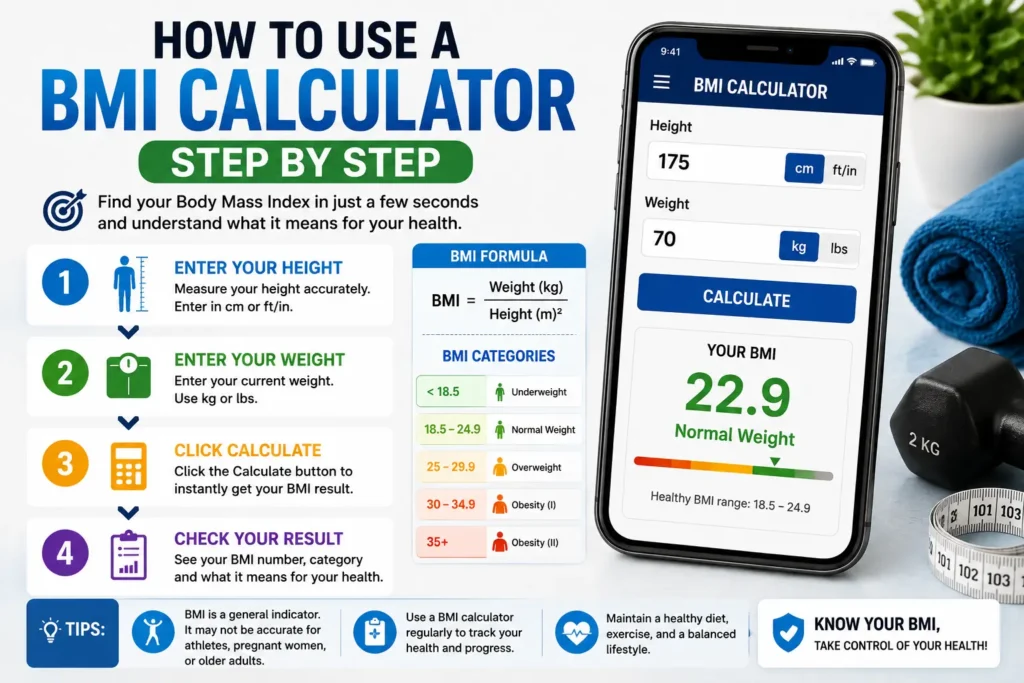
If you’re wondering how to use a bmi calculator correctly, the process is nearly identical across every legitimate version online:
- Enter your height — in feet/inches or centimeters.
- Enter your current weight — in pounds or kilograms.
- Select your unit system — imperial (US) or metric — before submitting.
- Submit the form to get your BMI score instantly.
- Read the category the result falls into (underweight, normal, overweight, or obesity).
This is also the fastest answer to how do i find out my bmi calculator result — skip manual math and let the tool calculate it directly. If you’d rather understand how to measure bmi calculator results by hand first, the formula above works the same way, just without the automatic lookup table.
Different Types of BMI Calculators — and Who They’re For
Not every BMI calculator is built the same way. Understanding which version applies to you makes the result far more useful:
- Bmi calculator men vs. bmi calculator female — The formula doesn’t change between sexes, but separate versions exist because healthy body fat percentage differs between men and women at the same BMI. A bmi calculator for guys typically just relabels the same standard calculation.
- Kids bmi calculator — Children and teens need age- and sex-specific percentile charts rather than fixed adult categories, since a healthy BMI for a 10-year-old looks nothing like a healthy adult range.
- Bmi calculator by age and bmi calculator women age tools — Some calculators factor in age brackets because muscle mass naturally declines over time, which affects how a given BMI score should be interpreted.
- Lean bmi calculator — Common among fitness-focused users trying to estimate lean body mass rather than total weight alone.
- Naval bmi calculator and usaf bmi calculator — The U.S. Navy and Air Force use body composition standards that go beyond plain BMI, often adding circumference measurements because standard BMI doesn’t distinguish muscle from fat — a real limitation for physically active service members.
- Anorexic bmi calculator — This term generally refers to using the standard BMI scale to flag severely underweight ranges. Because this touches on a health condition, results should always be reviewed by a medical professional rather than self-diagnosed from an online tool.
- Black bmi calculator — Some researchers have discussed whether BMI thresholds should be adjusted across different ethnic groups, since body composition at the same BMI can vary by population. This remains an area of ongoing public health discussion rather than a settled universal standard.
- Halls bmi calculator — This refers to one of several long-running independent BMI tools online. It uses the same standard formula described above; the name simply identifies which specific calculator a reader encountered.
Whatever the version, the underlying math is consistent — what changes is how the result should be interpreted for that specific group.
Why BMI Isn’t the Full Picture
BMI is a useful screening tool, not a diagnosis. It has real limitations worth understanding before you rely on it:
- It doesn’t distinguish between muscle and fat, so a muscular athlete can register as “overweight” despite low body fat.
- It doesn’t account for where fat is stored on the body, which matters for certain health risk assessments.
- It applies the same categories to most adults regardless of age, even though body composition shifts over time.
- It isn’t designed for children without age-specific percentile adjustments.
This is why many health guidelines recommend pairing BMI with other measurements — like waist circumference or body fat percentage — instead of treating it as a stand-alone verdict.
Common Mistakes People Make With BMI Calculators
- Treating BMI as a diagnosis. It’s a screening number, not a medical conclusion about your health.
- Ignoring muscle mass. Athletes and heavily muscled individuals often score “overweight” or “obese” despite low body fat.
- Using adult categories for children. Kids need percentile-based charts, not standard adult ranges.
- Entering inaccurate height or weight. Even small measurement errors can shift your result into a different category.
- Mixing up unit systems. Entering weight in kilograms while the height field is still set to inches produces a meaningless number.
Practical Tips for Using a BMI Calculator Correctly
- Measure your height and weight accurately before entering them — standing straight, without shoes, ideally in the morning.
- Recheck your results periodically rather than relying on one measurement, since normal weight fluctuation is expected.
- Use BMI as one data point among several, not your only health metric.
- If your result falls outside the “normal” range, talk to a healthcare provider before making major lifestyle changes.
- For children, always use an age- and sex-specific calculator instead of the standard adult version.
Final Takeaway
A BMI calculator gives you a quick, formula-based estimate of whether your weight falls into a typical range for your height — nothing more, nothing less. It’s a solid starting point, especially when you need a fast, no-hassle number, but it works best alongside other health contexts rather than as a stand-alone verdict. For an instant, accurate result, use the BMI calculator, part of the broader collection of free tools at Rapid Tool Plus.
Frequently Asked Questions
Is a BMI calculator accurate for everyone? No. It’s a reasonable general screening tool for most adults but is less reliable for athletes, older adults, pregnant women, and children, whose body composition differs from the general population the formula was built around.
What’s considered a healthy BMI? Most health organizations define 18.5–24.9 as the “normal weight” range for adults, though this should be considered alongside other health indicators rather than in isolation.
Can I calculate BMI without a calculator? Yes, using the formula weight ÷ height², but an online tool removes the risk of manual math errors and instantly shows which category your result falls into.
Do BMI calculators differ between countries? The math formula is universal, but some public health bodies apply the same standard categories while others adjust thresholds for specific populations.
Is BMI different for men and women? The calculation formula is identical, but healthy body fat percentages naturally differ between men and women at the same BMI, which is why separate labeled tools sometimes exist.
Why do military BMI calculators seem different? Military branches often combine BMI with additional circumference measurements to better estimate body composition for physically demanding roles, rather than relying on BMI alone.