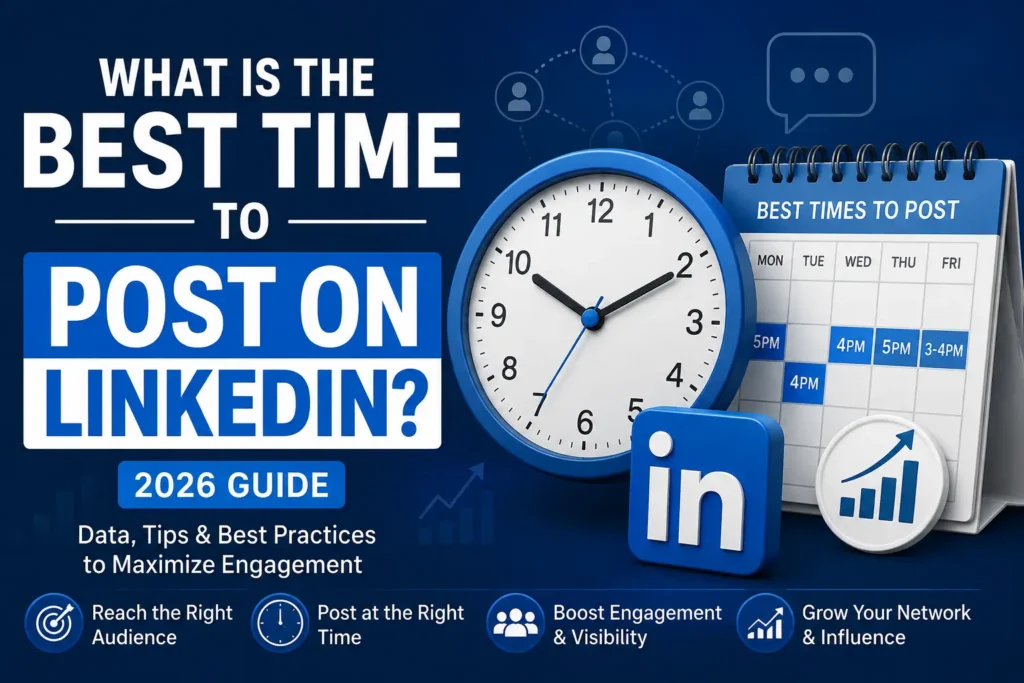
Posting on LinkedIn at the right time can help your content get in front of more people when they are actively checking their feeds. But there is no universal hour that guarantees high engagement for every account.
Recent 2026 research shows an interesting shift in LinkedIn behavior. Buffer’s analysis of more than 4.8 million LinkedIn posts found that late-afternoon and evening periods are currently strong, with 3:00 PM to 8:00 PM on weekdays standing out overall. Wednesday at 4:00 PM, Friday at 3:00 PM, and Friday at 4:00 PM were among the strongest individual slots in that dataset.
At the same time, other 2026 datasets point toward morning posting, especially for U.S. audiences. MagicPost’s analysis of more than 543,000 U.S. posts found the strongest results around 7:00 AM to 8:00 AM Eastern Time.
That difference is important. The best time to post on LinkedIn depends on your audience, industry, location, content type, and existing engagement patterns. Use general research as a starting point, then use your own analytics to identify the time that works best for you.
What Is the Best Time to Post on LinkedIn?
For a practical starting point in 2026, test these weekday windows in your audience’s local time:
| Day | Starting Time to Test | Best Use |
| Monday | 5:00 PM–9:00 PM | Professional updates, lighter content |
| Tuesday | 4:00 PM–6:00 PM | Educational and industry content |
| Wednesday | 3:00 PM–5:00 PM | High-priority posts |
| Thursday | 5:00 PM–7:00 PM | Thought leadership and business content |
| Friday | 3:00 PM–5:00 PM | Tips, insights, career-related content |
These times are starting points rather than fixed rules. Buffer’s 2026 dataset found Wednesday to be the strongest overall day, followed by Thursday and Friday, while Monday and Tuesday were weaker in that particular dataset.
However, another large U.S.-focused study found that early weekday mornings, particularly around 7:00 AM to 8:00 AM Eastern, performed especially well.
So instead of asking, “What is the one perfect LinkedIn posting time?” A better question is: Which posting window consistently produces the best results for my audience?
Why Does Posting Time Matter on LinkedIn?
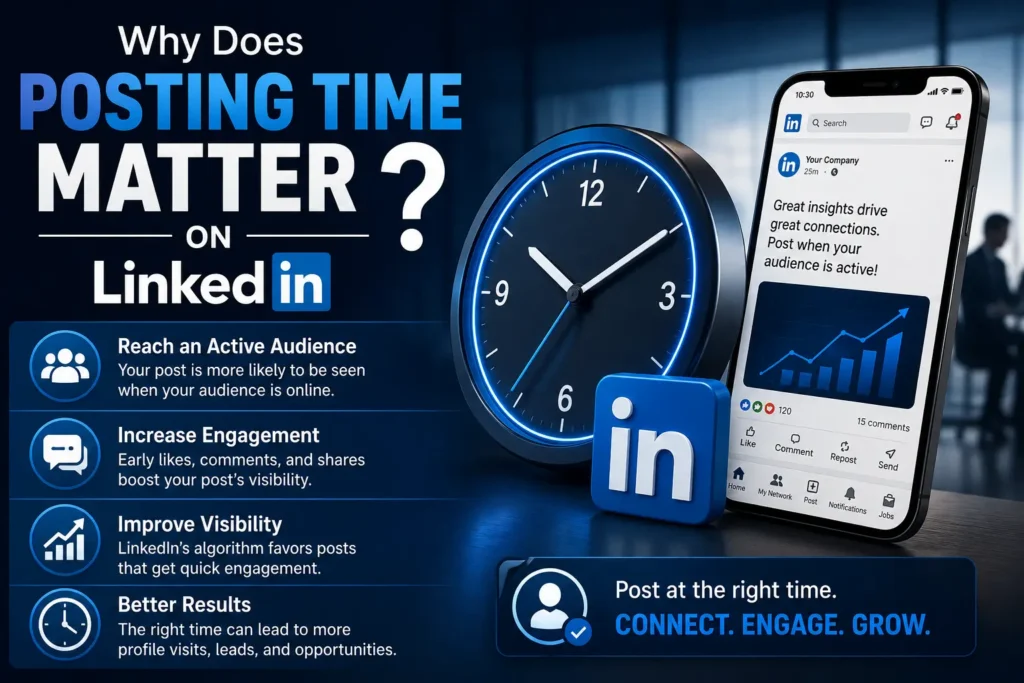
Timing matters because your post needs an active audience. Publishing when the people you want to reach are online gives the content a better opportunity to attract early reactions, comments, clicks, and other forms of engagement.
LinkedIn itself provides post analytics that include impressions, social engagement, link engagement, profile activity, and viewer demographics. These metrics can help you understand how individual posts perform and who is seeing them. (LinkedIn)
Timing is only one part of the equation, however. A post published during a popular time can still perform poorly if the topic is irrelevant, the opening is weak, or the content does not give people a reason to interact.
Think of timing as an optimization factor rather than a replacement for good content.
Best Times to Post on LinkedIn by Day
Monday
Monday can be difficult because many professionals are focused on meetings, planning, email, and weekly priorities.
Buffer’s 2026 analysis found Monday among the weaker days overall, although some late-day slots performed better than others.
For Monday, start by testing 5:00 PM rather than automatically assuming that early morning is best.
This can work particularly well for:
- Weekly industry observations
- Short professional tips
- Career advice
- Productivity content
- Discussion-based posts
Keep your strongest content for a day that consistently performs better for your audience.
Tuesday
Tuesday is often considered a strong professional networking day, but current research does not completely agree on its exact peak.
Buffer found Tuesday’s strongest slots around 4:00 PM and 5:00 PM, while other studies have reported stronger morning performance.
That makes Tuesday an excellent day for experimentation.
Try one Tuesday post in the morning and another at 4:00 PM or 5:00 PM over separate weeks. Compare impressions, engagement rate, comments, and clicks rather than judging the result from a single post.
Wednesday
Wednesday is one of the strongest days to test.
Buffer’s 2026 analysis identified Wednesday at 4:00 PM as the highest-performing individual time slot in its dataset, with 3:00 PM and 5:00 PM also performing well.
Wednesday can be a good choice for your most important weekly LinkedIn post, including:
- Original industry insights
- Detailed educational content
- Thought leadership
- Case-study-style lessons
- Professional opinions
- Product or company updates with genuine value
Thursday
Thursday also performed strongly in Buffer’s research, particularly around the late afternoon and early evening. 5:00 PM was the leading Thursday slot in that dataset.
This is useful for audiences who have more time later in the workday to read, react, and participate in discussions.
Friday
Friday can be valuable when you match the content to the mindset of your audience.
Buffer found 3:00 PM and 4:00 PM among the strongest Friday posting times and ranked Friday as one of the strongest days overall.
Good Friday content may include:
- Weekly lessons
- Industry roundups
- Quick tips
- Career insights
- Professional reflections
- Questions designed to start discussion
Avoid making every Friday post a generic “Happy Friday” update. Give the reader something useful.
What Is the Best Time to Post on LinkedIn in the USA?
For a U.S. audience, time zones are especially important.
A post that goes live at 9:00 AM Eastern does not reach everyone at the same stage of the workday. Your audience may be spread across Eastern, Central, Mountain, and Pacific time zones.
Current research illustrates why there is no single universal answer. MagicPost’s 2026 U.S. analysis found the strongest window around 7:00 AM to 8:00 AM Eastern, while Buffer’s much larger cross-audience dataset found stronger engagement later in the day.
For a broad U.S. audience, test several local-time windows rather than choosing one based on a generic chart.
A useful experiment could be:
Test A: 8:00 AM Eastern
Test B: 12:00 PM Eastern
Test C: 4:00 PM Eastern
Test D: 7:00 PM Eastern
Keep the topic, format, and quality reasonably consistent while testing. This gives you a cleaner comparison.
What Is the Best Time to Post on LinkedIn in the UK?
For a UK audience, use the same principle: think in terms of UK local time, not U.S. recommendations.
A reasonable starting experiment is:
- 8:00 AM–9:00 AM
- 12:00 PM–1:00 PM
- 4:00 PM–6:00 PM
The strongest window can vary significantly between industries.
For example, a recruitment professional may reach people during a morning commute, while a software company targeting decision-makers may see stronger activity later in the workday.
How Do I Post on LinkedIn?
Creating a LinkedIn post is straightforward, but the content itself needs structure.
A useful workflow is:
1. Choose One Clear Idea
Do not try to explain five unrelated topics in one post.
Start with one useful point, such as:
Three mistakes companies make when writing job descriptions.
2. Write a Strong Opening
The first lines should give the reader a reason to continue.
Instead of:
We are excited to share another company update.
Try:
Your job description may be losing qualified applicants before they ever reach the application form.
The second version creates a clear reason to keep reading.
3. Make the Post Easy to Scan
Use short paragraphs, spacing, and a logical flow.
Long blocks of text can make otherwise useful information difficult to consume in a social feed.
4. Add Evidence or an Example
Instead of simply stating an opinion, explain it.
For example:
If your LinkedIn posts consistently receive views but few comments, test a direct question at the end rather than ending with a generic call to action.
5. End With a Useful Question
A thoughtful question can encourage relevant discussion.
Avoid questions that feel artificially added just to increase comments.
Best Time to Post LinkedIn Content for Different Goals
Your ideal posting time may change depending on what you are trying to achieve.
For Job Seekers
Career-related posts can work well when professionals are actively browsing their networks.
Test weekday morning and late-afternoon periods. Share content such as:
- Career lessons
- Professional achievements
- Portfolio projects
- Industry insights
- Job-search experiences
For Recruiters
Recruiters may want to reach both active candidates and passive professionals.
Job-related posts should provide context rather than simply posting a job link.
For example, explain the role, the team, the problem the new hire will solve, or the skills that matter most.
LinkedIn also allows organizations to create Page posts and review metrics such as impressions, reach, clicks, comments, reactions, reposts, and engagement rate. (LinkedIn)
For Businesses and B2B Brands
Educational posts often deserve priority over purely promotional updates.
Test late afternoon, midweek periods, and the hours when your specific decision-makers are most likely to check LinkedIn.
The most important metric is not simply how many people saw the post. Look at whether the people you want to reach actually interacted with it.
How to Find Your Own Best Time to Post on LinkedIn
General studies can tell you where to start. Your analytics should tell you where to stay.
LinkedIn provides analytics for individual posts, including impressions, engagement, link engagement, profile activity, and audience demographics.
Use this simple testing process:
Step 1: Pick Three or Four Time Slots
For example:
- 8:00 AM
- 12:00 PM
- 4:00 PM
- 7:00 PM
Step 2: Test Them Repeatedly
Do not judge a time slot from one post.
Test each window over multiple posts while keeping the overall content quality reasonably consistent.
Step 3: Record the Results
Track:
- Impressions
- Engagement rate
- Reactions
- Comments
- Reposts
- Link clicks
- Profile activity
Step 4: Look for Patterns
Suppose your 8:00 AM posts average moderate reach but your 4:00 PM posts consistently receive more comments and profile visits.
That is more useful to you than a generic article claiming that everyone should post at 9:00 AM.
Step 5: Refine Your Schedule
Once a pattern becomes clear, prioritize your strongest content during the strongest window.
Continue testing periodically because audience behavior can change.
Does the Type of LinkedIn Post Affect the Best Time?
Yes. The audience you want to reach may not behave the same way for every content format.
An educational text post may perform differently from a hiring announcement, video, document, poll, or company update.
For example, a professional audience might have time for a short opinion during the workday but interact more with longer educational content later in the afternoon.
That is why it is useful to compare both posting time and post type in your analytics.
Should You Post on LinkedIn on Weekends?
You can, but weekdays are generally the better starting point for professional content.
Buffer’s 2026 analysis found lower overall engagement on weekends than on the strongest weekdays, although Saturday morning and some late-evening Sunday periods still showed activity.
Weekend posting may make sense when your audience includes:
- Entrepreneurs
- Freelancers
- Creators
- Global audiences
- Industries that operate outside traditional schedules
Do not completely eliminate weekends if your own data shows otherwise.
Common LinkedIn Posting Mistakes
Relying on One “Perfect” Time
No research can predict the exact best time for every LinkedIn audience.
Different studies are producing different results in 2026, which itself is evidence that audience composition matters.
Ignoring Time Zones
A U.S. audience spread across four major time zones should not automatically be treated like a single local audience.
Posting Without Measuring
If you never record performance, you cannot determine whether your schedule is improving.
Focusing Only on Impressions
A post with fewer impressions but highly relevant profile visits or comments may be more valuable than a post with broad but irrelevant reach.
Publishing Weak Content at a “Perfect” Time
Timing cannot fix an unhelpful post.
A useful post at a slightly less popular time can outperform a weak post published during a statistically strong window.
Practical Tips for Better LinkedIn Posts
Start with a strong first sentence. Make the post about one useful idea. Keep paragraphs short. Use examples instead of vague claims. Ask relevant questions rather than engagement-bait questions.
Also, engage with responses after publishing. A post can become more valuable when the author actively participates in the conversation rather than treating publication as the end of the process.
LinkedIn also supports scheduled posts, allowing users to prepare content ahead of time and publish it at a chosen date and time. LinkedIn’s scheduling feature currently supports standard posts, although some content types have restrictions.
For publishers managing a regular content calendar, scheduling can make consistent testing much easier.
Where Rapid Tool Plus Fits Into a LinkedIn Content Workflow
Readers who regularly create professional social content can also use Rapid Tool Plus to support the writing and optimization process. Its LinkedIn Post Generator can help turn an idea into a structured LinkedIn post, while related resources such as a free meta title generator, SEO-focused tools, social media generators, and other online generators and calculators can support different parts of a content workflow. These tools are most useful as productivity aids: the final post should still be reviewed, personalized, and adjusted to match the audience and the platform. Visit Rapid Tool Plus to explore its broader collection of free online tools.
Final Takeaway
The best time to post on LinkedIn is not one fixed hour shared by every creator, company, recruiter, or job seeker.
For 2026, a sensible starting point is to test Wednesday through Friday, especially during late-afternoon periods such as 3:00 PM to 5:00 PM. At the same time, test morning slots because some U.S.-focused data shows strong performance around 7:00 AM to 8:00 AM Eastern.
The most reliable strategy is to use these published benchmarks as starting points and then make decisions using your own LinkedIn analytics. Find when your audience is active, publish your strongest content during those windows, and keep refining the schedule as your audience changes.
Frequently Asked Questions
What is the best time to post on LinkedIn?
There is no universal best time. Current 2026 research varies, with one large Buffer dataset showing strong engagement from roughly 3:00 PM to 8:00 PM on weekdays, while another U.S. study found 7:00 AM to 8:00 AM Eastern particularly effective.
What is the best day to post on LinkedIn?
Wednesday is a strong starting point. Buffer’s 2026 analysis ranked Wednesday first, followed by Thursday and Friday.
Is morning or afternoon better for LinkedIn?
The answer depends on the audience and dataset. Some research favors morning, while Buffer’s latest large-scale analysis found stronger afternoon and evening performance. Test both instead of assuming one is always better.
How often should I post on LinkedIn?
Consistency is more useful than randomly posting whenever you remember. Start with a manageable schedule and use your analytics to determine whether increasing or changing your frequency improves results.
Can I schedule LinkedIn posts?
Yes. LinkedIn provides built-in scheduling for supported post types, allowing users to select a future date and time instead of publishing immediately.
Does posting at the right time guarantee more engagement?
No. Timing may improve the opportunity to be seen by an active audience, but it does not guarantee reach, engagement, clicks, or other outcomes. Content quality, relevance, audience, format, and many other factors also matter