Instagram hashtags have changed significantly in recent years. They can still help Instagram understand the topic of a post and connect content with relevant searches, but simply adding a huge list of popular hashtags is no longer a strong strategy.
In December 2025, Instagram announced that posts and Reels would be limited to five hashtags, encouraging creators to use fewer, more specific tags instead of large collections of generic ones. Instagram also made clear that hashtags should be relevant to the content rather than treated as a shortcut to guaranteed reach.
That makes choosing the right Instagram hashtag more important than choosing the most famous hashtag.
This guide covers 50+ best Instagram hashtags for 2026, hashtag ideas by niche, how to choose relevant tags, how to use Instagram hashtags correctly, and how an Instagram hashtag generator can help you find suitable combinations.
What Is an Instagram Hashtag?
An Instagram hashtag is a word or phrase preceded by the # symbol, such as #DigitalMarketing or #TravelPhotography.
Hashtags categorize content around a particular topic. When used naturally, they can provide additional context about a post and help users discover related content.
For example, a travel creator could publish a photo from London with:
#LondonTravel #UKTravel #TravelPhotography #LondonGuide #TravelTips
These tags tell Instagram and users what the content is about.
The important point is relevance. A popular hashtag that has nothing to do with your post is usually less useful than a smaller, highly specific tag that accurately describes your content.
How Many Instagram Hashtags Should You Use in 2026?
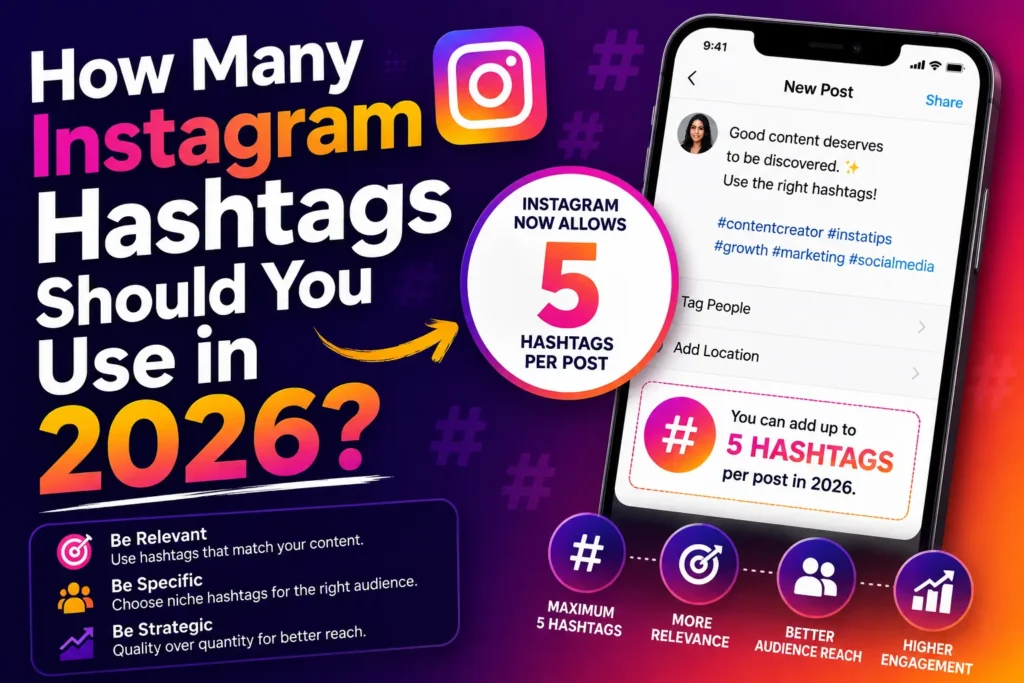
Instagram now limits posts and Reels to five hashtags. The platform has said that using fewer, more targeted hashtags can provide a better experience than filling a post with generic tags.
So, although this guide contains more than 50 hashtag ideas, you should not paste all of them into one Instagram post.
Instead, create different five-hashtag combinations based on:
- Your content topic
- Your niche
- Your target audience
- The location, when relevant
- The specific subject of the post
Think of a large hashtag list as a research library, not a list to paste under every post.
50+ Best Instagram Hashtags for 2026
The following are examples of commonly useful hashtags across different content categories. Their suitability depends on the actual post, audience, and niche.
General Instagram Hashtags
- #InstagramTips
- #ContentCreator
- #SocialMediaTips
- #ContentCreation
- #DigitalCreator
- #CreatorCommunity
- #SocialMediaMarketing
- #OnlineBusiness
- #PersonalBrand
- #ContentMarketing
- #MarketingTips
- #DigitalMarketing
- #SmallBusiness
- #Entrepreneur
- #BusinessTips
Lifestyle Hashtags
- #Lifestyle
- #LifestyleBlog
- #DailyLife
- #LifeStyleTips
- #SelfGrowth
- #Mindset
- #DailyInspiration
- #PositiveMindset
- #PersonalGrowth
- #HealthyLifestyle
Travel Hashtags
- #Travel
- #TravelPhotography
- #TravelTips
- #TravelGuide
- #TravelInspiration
- #Wanderlust
- #ExploreMore
- #TravelDiaries
- #AdventureTravel
- #VacationIdeas
Food Hashtags
- #Food
- #Foodie
- #FoodPhotography
- #FoodLover
- #FoodBlog
- #RecipeIdeas
- #EasyRecipes
- #HomeCooking
- #FoodInspiration
- #CookingTips
Fashion Hashtags
- #Fashion
- #FashionStyle
- #StyleInspiration
- #FashionInspo
- #OutfitIdeas
- #StreetStyle
- #DailyStyle
- #StyleTips
- #FashionTrends
- #MensFashion
Photography Hashtags
- #Photography
- #PhotographyTips
- #PortraitPhotography
- #StreetPhotography
- #PhotoOfTheDay
- #PhotographyLovers
- #CreativePhotography
- #MobilePhotography
- #LandscapePhotography
- #PhotoTips
These examples should be treated as starting points rather than a guaranteed list of the most popular hashtags on Instagram. Popularity changes by audience, location, topic, and platform behavior.
Best Hashtags for Instagram: How to Choose Them
The best hashtag is not necessarily the one with the biggest audience.
A useful way to select hashtags is to combine different levels of specificity.
1. Broad Topic
Start with the general subject.
For a marketing post:
#DigitalMarketing
2. Specific Subtopic
Add a more focused description.
#ContentMarketing
3. Audience or Industry
Identify who the content is for.
#SmallBusiness
4. Content Type
Describe what you are publishing.
#MarketingTips
5. Location or Community
Use a location or community hashtag when it genuinely matches the post.
For example:
#LondonBusiness
A five-hashtag set could therefore look like:
#DigitalMarketing #ContentMarketing #MarketingTips #SmallBusiness #LondonBusiness
This is usually more useful than combining five huge, unrelated hashtags.
Trending Instagram Hashtags: What Does “Trending” Actually Mean?
People often search for trending Instagram hashtags, Instagram trending hashtags today, or current trending hashtags because they want a tag that is currently popular.
The problem is that there is no permanent list of hashtags that will remain trending.
A hashtag may become popular because of:
- A major event
- A seasonal topic
- A cultural moment
- A sports event
- A new product
- A viral conversation
- A holiday
- A creator trend
- A news story
For that reason, be careful with websites that claim a specific hashtag is guaranteed to be the “hottest” or “most viral” tag without explaining how the information was measured.
For an evergreen article, it is better to teach readers how to identify current hashtags rather than pretend that today’s trending list will remain accurate throughout 2026.
How to Find Trending Hashtags on Instagram
When you want current hashtag ideas, start with the content itself.
Search the main topic
Enter a relevant keyword into Instagram’s search experience and examine related content and accounts.
Look at your niche
Pay attention to the terminology used by creators who publish genuinely similar content.
Study recent posts
Do not copy another creator’s entire hashtag set. Instead, identify recurring topic-specific terms that actually describe your own content.
Check seasonal relevance
A hashtag related to a holiday, event, location, or current topic may have value for a limited period.
Remove irrelevant tags
A hashtag should describe the content, audience, or context of your post. Popularity alone is not enough.
Because Instagram has moved toward fewer, more targeted hashtags, choosing five relevant tags is now more important than building a 20- or 30-tag collection.
Instagram Hashtags vs Instagram Tags
The terms are often confused.
A hashtag uses the # symbol:
#DigitalMarketing
An Instagram tag generally refers to tagging another Instagram account by using @username.
For example:
@examplebrand
The two features serve different purposes.
Hashtags describe topics and content categories. Account tags identify people, creators, brands, or other accounts.
How Do You Tag Someone on Instagram?
To tag someone in a post, use Instagram’s tagging option while creating or editing the post and select the relevant account.
You can also mention an account in a caption by typing @ followed by its username.
For Stories, Instagram provides a mention option that allows you to mention another account.
The exact interface can change as Instagram updates its app, so menu names and placement may differ between devices and versions.
How to Use Instagram Hashtags Correctly
A good hashtag strategy is simple.
Keep hashtags relevant
If your post is about running shoes, use tags related to running, footwear, fitness, or your specific audience.
Do not add unrelated tags simply because they are popular.
Use specific wording
Compare:
#Fitness
with:
#BeginnerRunningTips
The second is much more descriptive.
Match hashtags to the post
Your hashtag selection should change when the subject changes. Using exactly the same five tags on every post can make your strategy less precise.
Place keywords naturally in your caption
Hashtags are only one part of contextual information. Write a useful caption that clearly explains what the post is about instead of depending on tags alone.
Avoid hashtag stuffing
Instagram’s five-hashtag limit is a major reason to move away from the old strategy of filling captions with long lists of generic hashtags.
Instagram Hashtags for Different Types of Posts
Your hashtag choices should reflect the purpose of the content.
Instagram Reels
For a Reel, choose hashtags related to the exact subject of the video.
For example, a beginner photography Reel might use:
#PhotographyTips #BeginnerPhotography #CameraTips #PhotoEditing #Photography
Instagram Business Posts
A small business could use a combination of industry, product, and audience terms:
#SmallBusiness #OnlineBusiness #BusinessTips #Entrepreneur #DigitalMarketing
Instagram Travel Posts
A destination-specific post should prioritize the actual place and travel subject:
#LondonTravel #UKTravel #LondonGuide #TravelPhotography #TravelTips
Instagram Food Posts
A recipe post could use:
#EasyRecipes #HomeCooking #RecipeIdeas #FoodPhotography #CookingTips
The exact combination should always depend on the post.
Instagram Hashtag Ideas for Captions
Hashtags can work alongside a caption without replacing it.
For example:
Caption:
Three simple changes made my weekly content planning much easier. Which one would you try first?
Relevant hashtags:
#ContentPlanning #ContentMarketing #MarketingTips #SocialMediaTips #ContentCreation
Notice that the caption itself explains the idea. The hashtags simply reinforce the topic.
This is a better approach than writing a caption that contains little information and relying on hashtags to carry the entire post.
Instagram 5 Hashtags: Build Better Sets
Since Instagram now restricts posts and Reels to five hashtags, create several small sets instead of one giant master list.
For example, a marketing account could prepare:
Set A — SEO
#SEO #SEOTips #KeywordResearch #ContentSEO #DigitalMarketing
Set B — Social Media
#SocialMediaTips #SocialMediaMarketing #ContentCreation #InstagramTips #DigitalMarketing
Set C — Small Business
#SmallBusiness #Entrepreneur #BusinessTips #OnlineBusiness #PersonalBrand
Then select the set that actually matches the content.
This approach keeps your hashtags specific and makes it easier to adapt them from post to post.
How an Instagram Hashtag Generator Can Help
Finding five relevant hashtags manually for every post can still take time, especially when you manage multiple topics or social accounts.
That is where a hashtag-generation tool can be useful.Rapid Tool Plus provides content and social-media utilities, including an Instagram Hashtag Generator. Depending on the task, an Instagram hashtag generator, free Instagram hashtag generator, AI Instagram hashtag generator, or Instagram tag generator can help you brainstorm relevant starting points faster. You can then review the suggestions, remove anything irrelevant, and select the small set that best fits your actual post. Rapid Tool Plus also provides other online generators and content tools for related marketing and social-media tasks.
Common Instagram Hashtag Mistakes
Using only the most popular hashtags
The biggest hashtag is not automatically the best hashtag for your content.
Using irrelevant trending hashtags
A trending topic may attract attention, but if your post has nothing to do with it, the tag does not accurately describe the content.
Copying the same five tags everywhere
Different posts can target different topics. Rotate your selection based on content relevance rather than random variation.
Ignoring the caption
Hashtags should support the post, not replace useful writing.
Treating hashtags as a guarantee of reach
Instagram itself has emphasized relevant, targeted hashtags while also indicating that hashtags are not a guaranteed shortcut to broader reach.
Are Viral Instagram Hashtags Still Important in 2026?
Viral hashtags can be useful when they genuinely relate to the content, but they should not be treated as a guaranteed growth tactic.
Instagram’s move toward a five-hashtag limit reflects a broader shift away from hashtag stuffing and toward more targeted categorization.
A better question is not:
“Which hashtag has the most posts?”
Instead ask:
“Which five hashtags most accurately describe this post and the people I want to reach?”
That change in thinking can help you build a more focused Instagram hashtag strategy.
Final Takeaway
The best Instagram hashtag in 2026 is the one that accurately matches your content, niche, audience, and context.
You can use the 50+ examples in this guide for research, but do not treat them as a list to paste into every post. Instagram has moved to a maximum of five hashtags for posts and Reels, making relevance and specificity more important than quantity.
Build a small collection of relevant hashtag sets for your main content categories, update them when trends or topics change, and review every tag before publishing.
Most importantly, make the post itself useful. Hashtags can support discovery and classification, but they should complement strong content rather than become the entire strategy.
Frequently Asked Questions
What are the best hashtags for Instagram in 2026?
The best hashtags depend on your niche and the specific content. Relevant, specific hashtags are generally more useful than simply choosing the largest or most popular tags.
How many hashtags can you use on Instagram in 2026?
Instagram has moved to a maximum of five hashtags for posts and Reels. The platform has encouraged creators to use fewer, more targeted hashtags rather than long lists of generic tags.
What are trending Instagram hashtags?
Trending hashtags are tags that are receiving increased attention around a current topic, event, community, or cultural moment. They change over time, so today’s trending hashtag may not be relevant tomorrow.
Should I use popular hashtags on Instagram?
You can use popular hashtags when they genuinely describe your content, but popularity should not be your only selection criterion. Relevance is more important.
What is an Instagram hashtag generator?
An Instagram hashtag generator is a tool that helps users discover or brainstorm hashtag ideas based on a topic or keyword. The suggestions should still be reviewed manually before publishing.
How do I generate hashtags for Instagram?
Start with the topic of your post, identify related niche and audience terms, review current relevant trends, and select up to five hashtags that accurately describe the content.