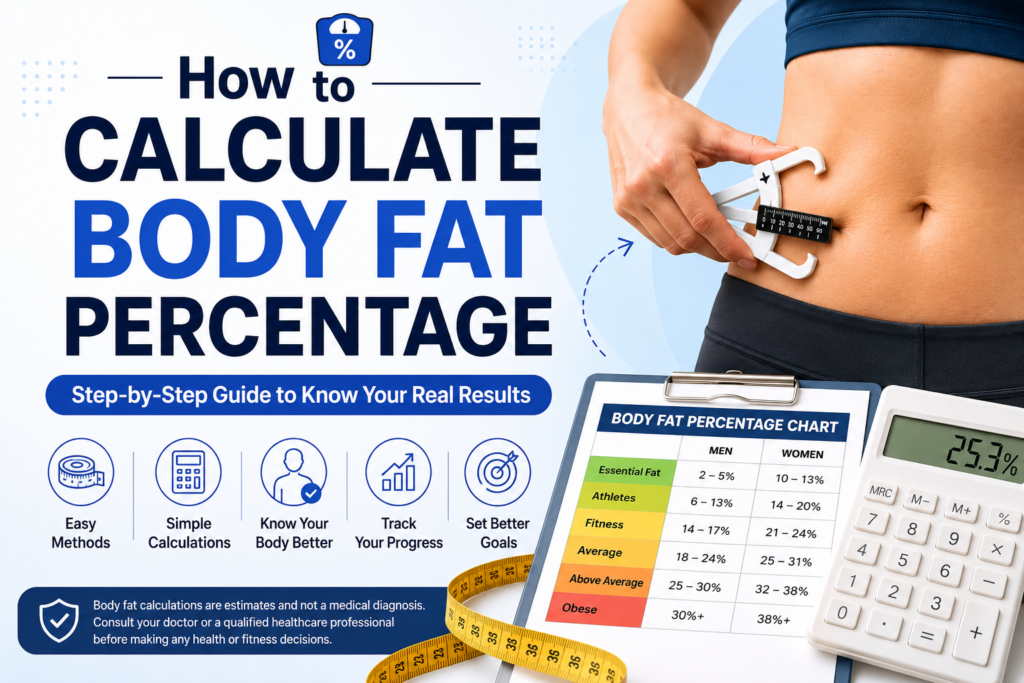
Your body weight tells you how much you weigh, but it does not tell you how much of that weight is body fat. Two people can have the same weight and height while having different amounts of fat and lean mass.
That is why learning how to calculate body fat percentage can be useful when tracking body composition. This guide explains what body fat percentage means, how it can be estimated at home, how tape measurements and BMI-based formulas work, and why different methods can produce different results.
Important health disclaimer: The information in this article is for general educational purposes only. Body-fat percentage calculations are estimates and should not be used to diagnose a health condition or replace professional medical advice. Before making significant changes to your diet, exercise routine, weight, or body-composition goals, speak with a qualified doctor, registered dietitian, or other appropriate healthcare professional. If you have a medical condition, are pregnant, are under 18, or have concerns about your weight or body composition, seek individualized medical guidance.
Quick Answer
Body fat percentage tells you how much of your body weight is fat versus lean mass (muscle, bone, water, organs). The fastest way to estimate it at home is the U.S. Navy Method, which only needs a measuring tape:
- For men: Body Fat % = 86.010 × log10(waist − neck) − 70.041 × log10(height) + 36.76
- For women: Body Fat % = 163.205 × log10(waist + hip − neck) − 97.684 × log10(height) − 78.387
- (all measurements in inches)
Don’t want to do the math by hand? Use our free Body Fat Calculator — just enter your measurements and get an instant, accurate result.
Why Body Fat Percentage Matters More Than Weight Alone
Two people can weigh exactly the same and look completely different. A muscular athlete at 180 lbs might have 12% body fat, while someone sedentary at the same weight might have 28%. Weight alone — and even BMI — can’t tell that difference. Body fat percentage gives you a much clearer picture of your actual health and fitness than the number on a scale.
Typical Healthy Ranges
| Category | Men | Women |
| Essential fat | 2–5% | 10–13% |
| Athletes | 6–13% | 14–20% |
| Fitness | 14–17% | 21–24% |
| Average | 18–24% | 25–31% |
| Above average | 25%+ | 32%+ |
Method 1: The Navy Method (Most Popular, No Equipment Needed)
The U.S. Navy Method is the most widely used at-home estimation because it only requires a flexible measuring tape — no special equipment.
What You’ll Need
- A flexible (cloth) measuring tape
- Your height
- Waist circumference (measured at the navel)
- Neck circumference (just below the larynx)
- Hip circumference for women (at the widest point)
Step-by-Step
- Measure your waist, neck (and hips if you’re a woman) in inches, standing relaxed — don’t suck in your stomach.
- Plug the numbers into the formula above, or skip the math and use our BMI & Body Fat Calculator.
- Compare your result to the healthy range table above.
Real Example
A 30-year-old male, 70 inches tall, with a 34-inch waist and 16-inch neck:
Body Fat % = 86.010 × log10(34 − 16) − 70.041 × log10(70) + 36.76 ≈ 15.3%
That falls in the “fitness” range — lean and healthy.
Accuracy
Within 3–4% of more expensive lab methods for most body types. Slightly less reliable for people with very high or very low muscle mass.
The Research Behind the Navy Method
The Navy Method isn’t just a popular internet formula — it has a documented research background.
Origin
The formula was developed by researchers Hodgdon and Beckett at the Naval Health Research Center in 1984, and the U.S. Navy has used it for personnel body composition screening since 1981. It was designed specifically to give the military an accurate, low-cost, no-equipment alternative to lab-based testing.
Validation
The formula has been validated against hydrostatic (underwater) weighing — the “gold standard” lab method for body composition — which is what gives it credibility as more than just a rough guess.
Accuracy Range
In practice, the Navy Method carries a margin of error of roughly ±3–5%. That means if the calculator returns 20%, your true body fat could reasonably fall anywhere between 15–25%. This might sound wide, but for most people the absolute number matters less than the trend:
- Measure every 3–4 weeks under the same conditions
- A movement like 22% → 20% → 18% is meaningful even if the exact starting number wasn’t perfectly precise
Ongoing Research
The Navy has continued evaluating body composition measurement methods in recent years, comparing the tape-measurement approach against DXA scans, 3D body scanners, and bioelectrical impedance analysis to determine which method best predicts fitness performance and health markers across different body types. This shows the method is still actively studied and refined — not something introduced once and left unchanged for 40 years.
Bottom Line
For a free, at-home method, the Navy Method’s accuracy is well-supported by decades of use and lab validation. It won’t replace a DEXA scan for clinical precision, but it’s more than reliable enough for personal tracking.
Method 2: BMI-Based Estimate
If you already know your BMI, you can get a rough body fat estimate using this formula (Deurenberg formula):
Body Fat % = (1.20 × BMI) + (0.23 × Age) − (10.8 × sex) − 5.4 (sex = 1 for men, 0 for women)
Haven’t calculated your BMI yet? Try our free BMI Calculator first, then plug the result into this formula.
Accuracy
Less precise than the Navy Method, especially for very muscular or very lean individuals, since BMI doesn’t distinguish muscle from fat. Best used as a quick sanity check, not your primary method.
Method 3: Skinfold Calipers
This method involves pinching the skin at specific points on your body (typically 3–9 sites depending on the protocol) and measuring the fold thickness with a caliper.
Common Measurement Sites
- Triceps
- Abdomen
- Thigh
- Chest
- Suprailiac (hip)
- Subscapular (back)
- Biceps
How It Works
- Pinch the skin firmly at each site, pulling the skinfold away from the muscle.
- Measure the thickness with the caliper.
- Take 2–3 readings per site and average them.
- Plug the total into a population-specific formula (Jackson-Pollock is the most common) to get your body fat percentage.
Accuracy & Cost
- Accuracy: Very good (within 3.5%) if performed correctly by a trained person. Self-measurement introduces more error since it’s hard to pinch consistently on your own back or thigh.
- Cost: $10–30 for a basic caliper — one of the cheapest accurate methods available.
Method 4: Bioelectrical Impedance Analysis (BIA)
This is the technology used in most smart scales and handheld body fat monitors. It sends a tiny, harmless electrical current through your body — since fat conducts electricity differently than muscle and water, the device estimates your body composition from the resistance.
Pros
- Fast, convenient, no expertise needed — just step on the scale
Cons
- Accuracy swings based on hydration level, recent exercise, and food/water intake
- Measuring first thing in the morning, before eating or drinking, gives the most consistent results
Accuracy
Good for tracking trends over time (are you losing fat month to month?), but less reliable for a single precise reading compared to calipers or the Navy method.
Comparison Table: Which Method Should You Use?
| Method | Accuracy | Cost | Equipment Needed | Best For |
| Navy Method | Good (±3–4%) | Free | Measuring tape | Quick, no-cost home estimate |
| BMI-based | Fair | Free | None | Fast sanity check |
| Skinfold calipers | Very good (±3.5%) | Low ($10–30) | Caliper | Accurate + affordable |
| BIA (smart scale) | Good for trends | Medium ($20–100+) | BIA device | Tracking progress over time |
| Hydrostatic weighing | Excellent (±1–2%) | High | Specialized facility | Maximum precision |
| DEXA scan | Excellent (±1%) | High | Medical facility | Clinical accuracy |
Our recommendation: Combine two methods for the most reliable picture — use the Navy Method or calipers for an accurate one-time estimate, and a BIA smart scale to track changes over weeks and months.
Try It Yourself
Skip the manual math, use our free Body Fat & BMI Calculator to get your result in seconds. Want to double-check your numbers or explore related calculations? Our free online calculator handles any additional math you need along the way.
Frequently Asked Questions
What’s a healthy body fat percentage?
For men, healthy ranges typically fall between 6–24%, and for women, 14–31%, depending on age and fitness level. Athletes usually sit at the lower end of these ranges.
Is BMI the same as body fat percentage?
No. BMI only compares your weight to your height — it doesn’t account for muscle mass. A muscular person can have a “high” BMI while actually having low body fat. Body fat percentage measures your actual fat-to-lean-mass ratio, making it a more accurate health indicator.
How accurate are smart scales?
Smart scales (using BIA) are reasonably accurate for tracking trends over time but can vary by a few percentage points depending on hydration, time of day, and recent food/exercise. For the most consistent results, always measure under the same conditions — first thing in the morning, before eating or drinking.
How often should I measure my body fat percentage?
Once every 2–4 weeks is enough to track meaningful changes. Measuring daily isn’t useful since body fat doesn’t fluctuate significantly day to day — you’ll mostly be seeing water weight noise.
Can I calculate body fat percentage without any tools?
The Navy Method only requires a flexible measuring tape, which makes it the most accessible no-equipment-cost option. For the fastest result, use our free online calculator instead of doing the math manually.