Instagram hashtags can still help give your content clearer topical context, but they are no longer a simple “use more tags and get more reach” tactic. Instagram has increasingly focused on personalized recommendations, original content, and relevance, while its hashtag limit has also changed. As of late 2025, Instagram moved to a maximum of five hashtags per post or Reel, making hashtag selection more important than hashtag volume.
The best approach in 2026 is to choose a small set of highly relevant instagram hashtags that accurately describe the content, audience, niche, or location. Below, you will find useful hashtag categories, examples, a practical selection method, common mistakes, and ways to test which tags make sense for your content.
Why Instagram Hashtags Still Matter for Reach
Hashtags are not a guaranteed route to viral content, followers, or engagement. Instagram’s recommendation systems now play a much larger role in deciding which posts and Reels users discover, and Meta continues to invest in personalized recommendations and original content.
That does not make hashtags useless. A relevant hashtag can help describe the subject of a post and connect it with a broader topic or community. Think of hashtags as labels that provide additional context rather than as a shortcut to popularity.
For example, a food creator posting a homemade pasta recipe might use tags related specifically to pasta, home cooking, and recipes. A travel creator visiting London might use location and travel-related hashtags instead of unrelated high-volume tags.
The key principle is simple: relevance should come before popularity.
Trending Instagram Hashtags: Categories That Make Sense
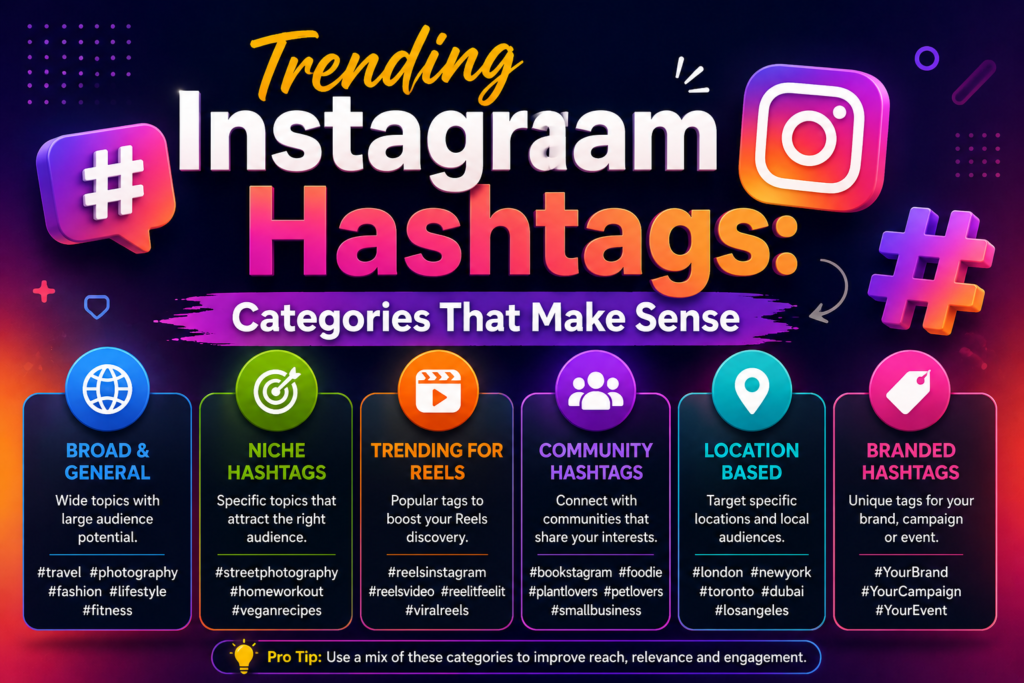
There is no single list of hashtags that will be “trending” for every account or niche at the same time. A hashtag can be popular while being a poor fit for a particular post. Instead of chasing every viral tag, build your hashtag choices around the type of content you publish.
1. Broad and General Hashtags
Broad tags describe large topics and can expose a post to a wide category of users.
Examples include:
- #Photography
- #Travel
- #Fashion
- #Fitness
- #Food
- #Beauty
- #Business
- #Marketing
- #Lifestyle
These are useful as topic signals, but broad hashtags can also be highly competitive. A smaller, more specific tag may provide better context for your content.
2. Niche Hashtags
Niche hashtags describe a narrower interest, profession, style, or community.
For example, a photography account could explore tags such as:
- #StreetPhotography
- #PortraitPhotography
- #MobilePhotography
- #TravelPhotography
- #PhotographyTips
A fitness creator could use:
- #StrengthTraining
- #HomeWorkout
- #RunningTips
- #MobilityTraining
- #FitnessForBeginners
Niche tags often make more sense than generic tags because they tell Instagram and users exactly what the content is about.
3. Trending Hashtags for Instagram Reels
Reels can benefit from clear topic and format signals, but a trending hashtag should only be used when it genuinely matches the Reel.
Examples might include a combination such as:
- #InstagramReels
- #ReelsTips
- #TravelReels
- #FoodReels
- #FitnessReels
Avoid adding a popular Reel-related hashtag simply because it is currently visible in other creators’ posts. A mismatch can make your hashtag set less useful.
4. Community Hashtags
Community hashtags can help connect content with groups that share a specific interest.
Examples include:
- #Bookstagram
- #Foodie
- #PlantLovers
- #PetLovers
- #SmallBusinessOwners
- #ContentCreators
These work best when the actual post contributes to that community rather than merely borrowing its hashtag.
5. Location-Based Hashtags
Location can be especially useful for travel, local businesses, events, restaurants, and creators targeting a specific area.
Examples:
- #London
- #NewYorkCity
- #Toronto
- #Dubai
- #Manchester
- #LosAngeles
You can also combine a location with the niche of the content, such as a restaurant, photography, fashion, or travel topic.
6. Branded Hashtags
A branded hashtag is created around a company, campaign, product, event, or recurring content series.
For example, a business might create a unique tag based on its brand name or campaign name. Because branded tags are more specific, they can be useful for organizing related posts and encouraging community participation.
Best Hashtags for Instagram: How to Choose the Right Ones
Choosing the best hashtags for Instagram is less about finding five famous words and more about selecting five accurate ones.
Use this four-step process.
Step 1: Start With the Main Topic
Ask what the post is actually about.
A photo of a home workout should begin with fitness-related ideas. A post about a London restaurant should focus on food and location rather than generic lifestyle tags.
Step 2: Narrow the Audience
Think about who would genuinely care about the post.
For example, instead of using only #Fitness, a strength-training post could be more specific with something like #StrengthTraining or #WorkoutTips.
Step 3: Balance Broad and Specific Tags
A useful set can combine different levels of specificity.
For a travel Reel, for example:
#Travel #TravelReels #LondonTravel #UKTravel #TravelTips
This gives the post a broad topic, a format, a location, and more specific context.
Step 4: Remove Anything That Does Not Fit
Before publishing, look at every hashtag individually.
Ask:
“Would a person interested in this hashtag reasonably expect to see this post?”
If the answer is no, remove it.
This simple check is more useful than copying a giant block of unrelated hashtags.
How Many Instagram Hashtags Should You Use?
Instagram currently limits posts and Reels to five hashtags, so the old strategy of adding dozens of tags is no longer appropriate. This limit became a platform-enforced restriction beginning in December 2025.
That means creators should treat each hashtag as a deliberate choice.
A practical five-tag structure could look like this:
1 broad topic + 2 niche topics + 1 audience/community tag + 1 location or format tag
For example, a London food Reel could use:
#Food #FoodieLondon #LondonRestaurants #FoodLovers #London
This is only an example framework, not a universal formula. The right combination depends on the content and intended audience.
Instagram also provides creators with a Best Practices area covering creation, engagement, reach, monetization, and guidelines, including guidance around features such as hashtags. Meta says this educational guidance is updated as its recommendations evolve.
Where Should Hashtags Go?
Because Instagram’s current limit applies to the post or Reel as a whole, splitting hashtags between the caption and comments does not create extra hashtag capacity.
The practical choice is to place your selected hashtags where they remain easy to manage and relevant to the post. More importantly, make sure the caption itself clearly explains the content.
Hashtags should support the message, not replace it.
For example, a caption full of unrelated hashtags does not become more relevant simply because it contains popular terms. Instagram increasingly relies on content context and recommendation systems, so a clear caption and strong piece of content remain important.
Common Instagram Hashtag Mistakes to Avoid
Using Irrelevant Viral Tags
A hashtag can be popular and still be completely wrong for your post. Adding unrelated trending hashtags can attract the wrong audience and make your content less clearly categorized.
Reusing the Exact Same Set Every Time
Copy-pasting the same five hashtags across every post may be convenient, but it prevents you from learning which topic combinations are most appropriate for different content.
Build several small sets instead.
For example, a fashion account might maintain separate groups for:
- Outfit posts
- Styling tips
- Product features
- Seasonal content
- Local fashion content
Choosing Hashtags Only Because They Are Popular
“Popular” does not automatically mean “useful.”
A highly competitive broad tag can be less descriptive than a niche tag that closely matches your content.
Ignoring the Caption
Hashtags are not a replacement for meaningful content. Write a caption that naturally explains what the post is about, then use hashtags as supporting topic signals.
Assuming Hashtags Guarantee Reach
There is no reliable hashtag combination that guarantees viral distribution, follower growth, or engagement. Instagram’s recommendation systems are dynamic, personalized, and influenced by many aspects of content and user behavior. Meta continues to emphasize recommendations and original content rather than relying on a single discovery mechanism.
Practical Tips for Finding Better Instagram Hashtags
Build Small Hashtag Sets
Instead of maintaining one giant list, create small sets based on your content categories.
A beauty creator could have separate groups for skincare, makeup, tutorials, product reviews, and beauty education.
Check the Relevance Before Every Post
Trends can change quickly. A hashtag that fits one post may have little relationship to the next.
Review your choices every time you publish.
Track Your Content Performance
Do not judge a hashtag only by whether it looks popular.
Compare posts with similar topics and look for useful patterns in your Instagram analytics. Test different combinations while keeping the content type reasonably consistent.
Use Trial Reels for Content Experiments
Instagram’s Trial Reels feature allows creators to test Reels with non-followers first and review performance before deciding how to share them more broadly. Meta introduced the feature specifically to make experimentation easier.
This can be useful when testing different content topics, hooks, formats, and hashtag combinations.
Watch Your Niche, Not Just Hashtag Lists
Spend time looking at successful accounts in your niche. Pay attention to the topics they cover, the language they use, and the communities around those topics.
Do not simply copy their hashtags. Use the research to understand how your audience describes the subject.
Tools That Can Speed Up Hashtag Research
When researching Instagram hashtags, tools can make the process faster. Rapid Tool Plus provides an AI hashtag generator and an Instagram hashtag generator free for generating relevant hashtag ideas from a topic or keyword. You can also use related resources such as an Instagram caption generator or Instagram bio generator when preparing the rest of your profile content; the important step is still reviewing the suggestions and selecting only hashtags that genuinely match the post.
Limitations: Hashtags Are Not a Guaranteed Growth Strategy
A strong hashtag strategy can improve the clarity and organization of your content, but it cannot guarantee reach.
Instagram’s recommendation systems are constantly changing, and many signals influence what users see. Meta has continued to increase the role of recommendations and original content in Instagram discovery. In early 2026, Meta reported that 75% of Instagram recommendations in the US were coming from original posts, illustrating how much broader the discovery system has become than hashtags alone.
This is why creators should focus on the complete content package:
- Relevant topic
- Useful or entertaining content
- Clear captions
- Strong creative execution
- Appropriate hashtags
- Audience engagement
- Consistent testing
Hashtags are one part of the strategy, not the entire strategy.
Final Takeaway
The best instagram hashtags in 2026 are not necessarily the most popular ones. They are the hashtags that accurately describe your content and help place it within the right topic, niche, community, or location.
Since Instagram now limits posts and Reels to five hashtags, quality and relevance matter more than quantity.
Start with the subject of your post, choose a combination of broad and specific terms, remove anything irrelevant, and track how your content performs over time. Most importantly, remember that hashtags cannot guarantee reach or virality. They should support high-quality content rather than attempt to compensate for weak content.
FAQs
What are the best trending Instagram hashtags in 2026?
There is no universal list of hashtags that is best for every account. The right choice depends on your content, niche, audience, and location. Focus on relevant hashtags rather than simply selecting the most popular ones.
How many hashtags can I use on Instagram?
Instagram currently limits posts and Reels to five hashtags. The change was introduced as a platform-wide restriction in December 2025.
Do Instagram hashtags increase reach?
Relevant hashtags can help provide context around a post, but they do not guarantee higher reach. Instagram’s broader recommendation system uses many signals beyond hashtags.
Should I use trending hashtags on Instagram Reels?
Use a trending hashtag when it genuinely describes the Reel. Do not add unrelated hashtags simply because they are popular.
Should I use the same hashtags on every Instagram post?
It is better to review and adjust your hashtags according to the content. You can maintain different hashtag sets for different topics, but each post should use tags that accurately describe what viewers will find.
Are niche hashtags better than popular hashtags?
Niche hashtags can be more precise because they describe a narrower subject or audience. A balanced selection of broad and niche hashtags can provide useful context without relying entirely on highly competitive terms.