Pinterest marketing is more than posting attractive images. For businesses, Pinterest can support brand discovery, product research, website traffic, shopping, and paid campaigns by putting content in front of people who are actively exploring ideas and products.
Pinterest describes itself as a place where people discover new ideas, plan, and shop, while its business platform provides tools for advertising, analytics, shopping, and audience measurement.
For a business, the goal is not simply to collect views or saves. A stronger Pinterest strategy connects useful content with the right search terms, attractive creative, a relevant landing page, and measurable business outcomes.
Build the right Pinterest foundation before publishing
A good Pinterest marketing strategy starts with the account itself.
A business should create a clear profile that tells visitors what it offers and who it serves. Your profile name, bio, boards, and Pin topics should all reinforce the same business theme instead of covering unrelated subjects.
For example, a home décor company might organize its content around:
- Small-space decorating
- Bedroom ideas
- Home office inspiration
- Modern kitchen design
- DIY organization
This creates a clearer topical relationship between the account and its content.
A business account is particularly useful because Pinterest says it unlocks business tools such as ads and analytics.
Your website should also be part of the strategy. Pinterest content can introduce someone to your brand, while the destination page gives them a next step such as learning more, signing up, or purchasing.
Think about Pinterest as a discovery and planning platform
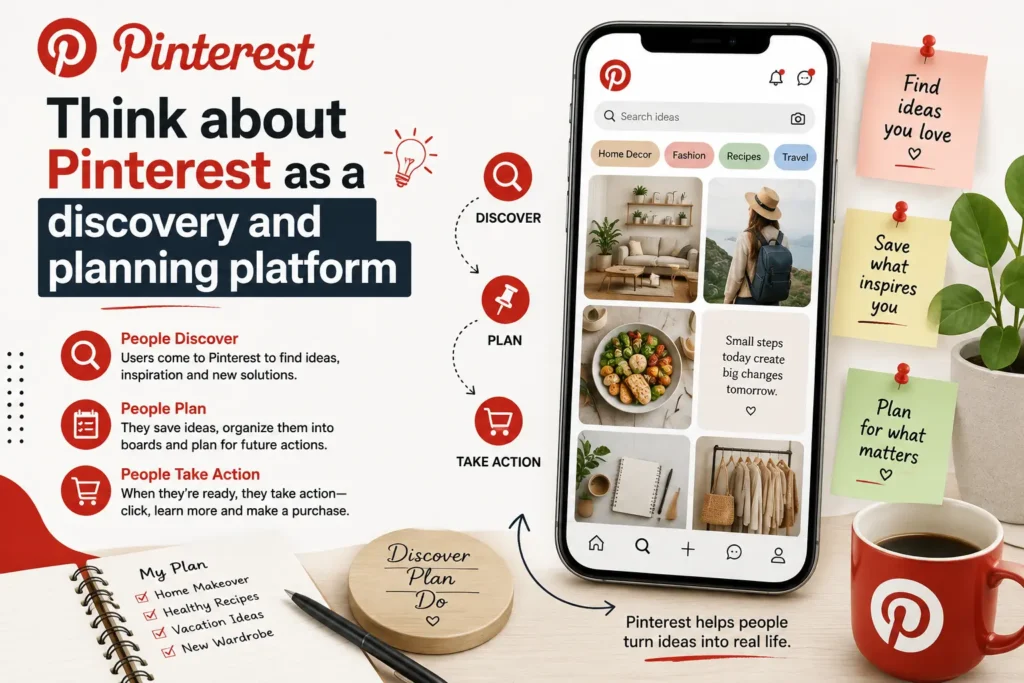
One of the biggest mistakes in Pinterest marketing is treating Pinterest exactly like Instagram or another feed-first social network.
Pinterest users often arrive with an idea, project, product, or future purchase in mind. Pinterest says its users come to discover new ideas, plans, and shops, and that finding new products and brands is a major reason people use the platform.
That changes the type of content a business should create.
Instead of publishing only:
“Our new product is here.”
A stronger Pin might answer a searcher’s need:
“5 Small Bedroom Storage Ideas for Apartments”
The second approach can attract someone who is still researching. Your product can then become part of the solution.
This is why Pinterest ecommerce strategies often work best when they combine inspiration with useful information.
Create content around what people are actually searching for
Pinterest SEO should start with the language your audience uses.
Your research can include:
- Product categories
- Problem-based searches
- Seasonal ideas
- Long-tail phrases
- Related interests
- Trend-driven terms
- Questions connected to your product
Pinterest itself provides a Trends tool that businesses can use to discover what is trending and what is inspiring audiences. Its 2026 marketing materials specifically recommend using Pinterest Trends to identify trending keywords and understand current interests.
This gives businesses an opportunity to plan content around rising topics rather than publishing randomly.
For example, a fashion store could research terms around:
spring outfits → capsule wardrobe → minimalist outfits → office outfits → neutral fashion
The objective is not to insert every variation into one Pin. It is to understand the broader topic and create content that genuinely matches different search needs.
Make every Pin useful before making it promotional
A commercial Pin can still be useful.
For example, an online furniture store could create:
“7 Ways to Style a Small Living Room”
and feature its sofa naturally within the room design.
A beauty brand could create:
“Simple Skincare Routine for Dry Skin”
and explain where its products fit into the routine.
This approach gives Pinterest marketing a broader content mix:
| Content type | Example |
| Educational | How to organize a small kitchen |
| Inspirational | Modern bedroom design ideas |
| Product-focused | Minimalist desk for a home office |
| Seasonal | Holiday table setting ideas |
| Comparison | Small vs. large outdoor furniture |
| Tutorial | How to style a gallery wall |
The best mix depends on the business, audience, and search behavior.
Pinterest descriptions and tags still need context
Pinterest content should be understandable without relying on visual design alone.
Your Pin title and description should clearly explain what the content is about, use relevant language naturally, and match the destination page.
This is where businesses sometimes make the mistake of stuffing unrelated hashtags or keywords into descriptions.
For example, a recipe Pin should not include a random collection of high-volume terms simply because they look popular. Relevance matters more than collecting as many keywords as possible.
Hashtags can be used when appropriate, but they should support the content rather than replace proper topic and keyword optimization.
The same principle applies to Pinterest tags and hashtag research: choose terms that describe the Pin, its subject, and the audience’s likely search intent. This discipline isn’t unique to Pinterest — the same “relevance over volume” rule applies when finding hashtags for Instagram or picking trending TikTok hashtags, so a business running multiple platforms can reuse the same research habits.
Use Pinterest for ecommerce, not just awareness
Pinterest can be especially useful for ecommerce because shopping is built into the platform’s business ecosystem.
Pinterest’s current shopping guidance recommends establishing a business presence, connecting a product catalogue, and using shopping or conversion campaigns to scale product visibility. Pinterest also supports ecommerce integrations and the Pinterest API for Shopping.
This creates a more connected path:
Search → Pin → Product → Website → Purchase
For example, an apparel company could publish Pins around:
- Summer outfit ideas
- Workwear inspiration
- Travel outfits
- Capsule wardrobes
- Styling guides
Product-focused Pins can then connect discovery content with products that customers can investigate or purchase.
This is also where terms such as shopify pinterest, etsy pinterest, pinterest shop, and pinterest for woocommerce become relevant to ecommerce businesses. The right technical setup depends on the platform and the business model, but the larger strategy is the same: make discovery easier and reduce friction between inspiration and action.
Use trends without chasing every trend
Pinterest Predicts 2026 provides an important lesson for businesses: trends can help shape content planning, but they should be adapted to the brand rather than copied blindly.
Pinterest says its 2026 trend report was built from billions of searches and engagement signals, and its business playbook encourages brands to use trends for content calendars, campaign ideas, shopping, and keyword decisions.
That means a trend becomes more valuable when it has a connection to your products or audience.
For instance:
A home décor brand can turn a rising color trend into room inspiration.
A beauty company can turn an emerging aesthetic into a tutorial.
A travel company can connect a popular style or cultural trend to destination inspiration.
The key is relevance. A trend that does not fit the business can create short-term attention without building a meaningful audience.
Combine organic Pinterest marketing with advertising
Organic content can help a business build a library of useful Pins over time. Paid advertising can then be used when there is a specific business objective.
Pinterest currently positions ads around goals such as awareness, consideration, leads, and sales.
A company might use organic content to build demand for a topic while using ads to promote:
- A bestselling product
- A seasonal collection
- A lead magnet
- A landing page
- A shopping campaign
- A specific product category
The important point is to avoid treating ads as a replacement for good content.
A paid campaign can increase distribution, but weak creative or an irrelevant landing page can still undermine performance.
Measure Pinterest marketing with the right metrics
Pinterest analytics becomes much more useful when metrics are tied to an actual business objective.
For awareness, you may care about reach and visibility.
For engagement, saves and other interactions can provide useful signals.
For website performance, outbound clicks and on-site behavior matter more.
For ecommerce, purchases and conversion-related actions become much more important.
Pinterest’s current analytics guidance recommends defining metrics around the business goal, monitoring performance, experimenting, and looking beyond last-click attribution when measuring impact.
Pinterest also highlights the role of its tag and Conversions API in understanding conversion activity and improving measurement.
If you want an outside benchmark for what “good” engagement looks like before setting your own targets, Sprout Social’s Pinterest statistics roundup is a useful external reference for typical save rates, purchase-intent data, and audience behavior.
A useful measurement framework is:
Content → Engagement → Clicks → Website behavior → Conversions
This helps identify where a strategy is working and where it needs improvement.
A simple content workflow for using Pinterest for business
A sustainable workflow is usually more effective than trying to create everything at once.
Start with a group of topics that directly connect to your products or services.
Next, research related searches and current trends.
Then create several content angles around each topic instead of publishing the same message repeatedly.
For example, one core product could produce:
Pin 1: Product-focused image Pin 2: How-to guide Pin 3: Inspiration post Pin 4: Comparison Pin 5: Seasonal use case
Each Pin can target a different search intent while leading to a relevant page.
This approach is particularly useful for small businesses that want to build Pinterest content consistently without creating a completely new idea every day.
Where Pinterest virtual assistants and designers fit in
Businesses do not always need one person to handle every part of Pinterest marketing.
A Pinterest virtual assistant may help with scheduling, organization, uploading, board management, research, or routine tasks.
A designer may focus on creating Pin graphics, templates, or branded visual assets.
A marketer may handle keyword research, analytics, testing, and campaign planning.
The important part is to keep these roles connected. Beautiful visuals without relevant topics may struggle to attract the right audience, while strong keyword research without compelling creative can limit engagement.
A practical approach to Pinterest marketing for small businesses
A small business does not need to start with dozens of boards or a large advertising budget.
A more manageable approach is:
Choose a focused niche. Build content around topics closely related to your products or services.
Create a few repeatable Pin formats. For example, list-style graphics, product guides, tutorials, and inspiration Pins.
Use relevant search language. Write for humans first, then refine titles and descriptions around genuine search intent.
Study performance. Identify the topics and formats that generate meaningful results.
Expand what works. Create additional content around successful themes rather than constantly starting from zero.
This makes Pinterest marketing easier to manage and gives the business a clearer feedback loop.
One useful Rapid Tool Plus workflow
When optimizing Pinterest content, research and consistency matter as much as the visual itself. Rapid Tool Plus provides resources that can support this workflow, including the Pinterest Tag Generator for generating relevant tag and hashtag ideas and the Pinterest Description Generator for drafting Pin descriptions; branded searches such as Rapid Tool Plus Pinterest Hashtag Generator can also help users find the relevant tool directly. These tools are best used as starting points, with the final keywords and descriptions reviewed for relevance to the actual Pin and audience.
What a strong Pinterest strategy looks like in practice
Imagine a small US-based home décor store selling minimalist furniture.
Instead of posting only product photos, its Pinterest marketing system could include:
Discovery content: “10 Minimalist Living Room Ideas”
Problem-solving content: “How to Make a Small Apartment Feel Bigger”
Product content: “Minimalist Coffee Tables for Small Spaces”
Seasonal content: “Fall Home Décor Ideas for Small Rooms”
Trend content: Content inspired by relevant 2026 Pinterest trends
Paid content: Promoted product or shopping campaigns for selected products
Measurement: Track which topics produce clicks, saves, product interest, and conversions.
The result is a content ecosystem rather than a collection of disconnected Pins.
Mistakes that can weaken Pinterest performance
Some common mistakes are strategic rather than technical.
Publishing visually attractive content with no clear search topic can make discovery harder.
Using the same keyword repeatedly across unrelated Pins can reduce relevance.
Sending every Pin to the homepage instead of the most relevant page creates unnecessary friction.
Copying trends that have no relationship to the brand can attract attention without useful business results.
Ignoring analytics makes it difficult to know which content deserves more investment.
Another frequent mistake is expecting Pinterest marketing to produce immediate results from a handful of posts. A stronger strategy treats content as an ongoing system that improves through testing and measurement.
How Pinterest marketing is changing in 2026
Pinterest’s 2026 business ecosystem shows a stronger connection between discovery, commerce, trends, advertising, and measurement.
Pinterest’s current materials emphasize shopping campaigns, catalog connections, trends, analytics, and new AI-powered business capabilities. In June 2026, Pinterest announced new AI-focused business tools designed to help marketers make decisions using more connected campaign context. (Pinterest)
For businesses, the practical takeaway is simple: Pinterest is becoming increasingly useful when content, search behavior, products, and measurement are considered together.
That does not mean every company should use every feature. The best strategy is still the one aligned with the business model and customer journey.
Final takeaway
Pinterest marketing works best when a business treats the platform as a discovery, planning, and commerce channel rather than simply another place to repost social media content.
Start with a clear business profile, research relevant topics, create useful visual content, optimize each Pin for its specific search intent, connect products or landing pages where appropriate, and use analytics to learn what actually drives business value.
For ecommerce brands, Pinterest can become especially valuable when product discovery, shopping features, advertising, and measurement work together. For service businesses and publishers, useful educational and inspirational content can create additional opportunities for discovery and website visits.
The goal is not to publish more Pins just for the sake of activity. The goal is to build a searchable, useful content system that gives the right audience a reason to discover, click, explore, and eventually take action.
FAQs
Is Pinterest marketing still useful for businesses in 2026?
Yes. Pinterest continues to position itself as a discovery and shopping platform and provides businesses with tools for advertising, analytics, trends, and commerce.
Is Pinterest good for ecommerce?
Pinterest can be particularly relevant for ecommerce because businesses can connect catalogues, create shopping experiences, and use shopping or conversion campaigns.
How do I find Pinterest SEO keywords?
Start with terms directly related to your products, audience problems, categories, and seasonal topics. Pinterest Trends can also help identify current search and interest patterns.
Do Pinterest hashtags matter for marketing?
Hashtags can support topical context, but businesses should not rely on hashtags alone. Relevant titles, descriptions, visual content, and broader keyword targeting are more important parts of a complete Pinterest strategy. A Pinterest hashtag generator can speed up the initial research, but every suggestion should still be checked against the actual Pin before it’s used.
Can I use Pinterest for WooCommerce or Shopify?
Yes, Pinterest’s current shopping ecosystem includes ecommerce integrations and catalogue-based workflows. The exact setup depends on your ecommerce platform and account configuration.
What should I track in Pinterest Analytics?
Track metrics that match your goal. Awareness campaigns may focus on reach, while traffic and ecommerce strategies should pay closer attention to clicks, conversions, and the customer journey. Pinterest recommends measuring performance against defined business objectives rather than relying on a single universal metric.