A strong meta description can make a search result more appealing before someone ever visits your website. The best meta description example is not simply a sentence containing keywords. It clearly communicates what the page offers, matches the searcher’s intent, and gives them a reason to choose your result.
Below are 25 practical examples covering blogs, homepages, ecommerce products, Shopify stores, SaaS pages, local businesses, services, and more. Each example highlights a different approach so you can see what makes a description more useful and compelling.
Google may choose to display text from the page itself rather than the HTML meta description, so writing a relevant page description is helpful but does not guarantee that the exact wording will appear in Search. Google has also clarified that page content is the primary source for snippets.
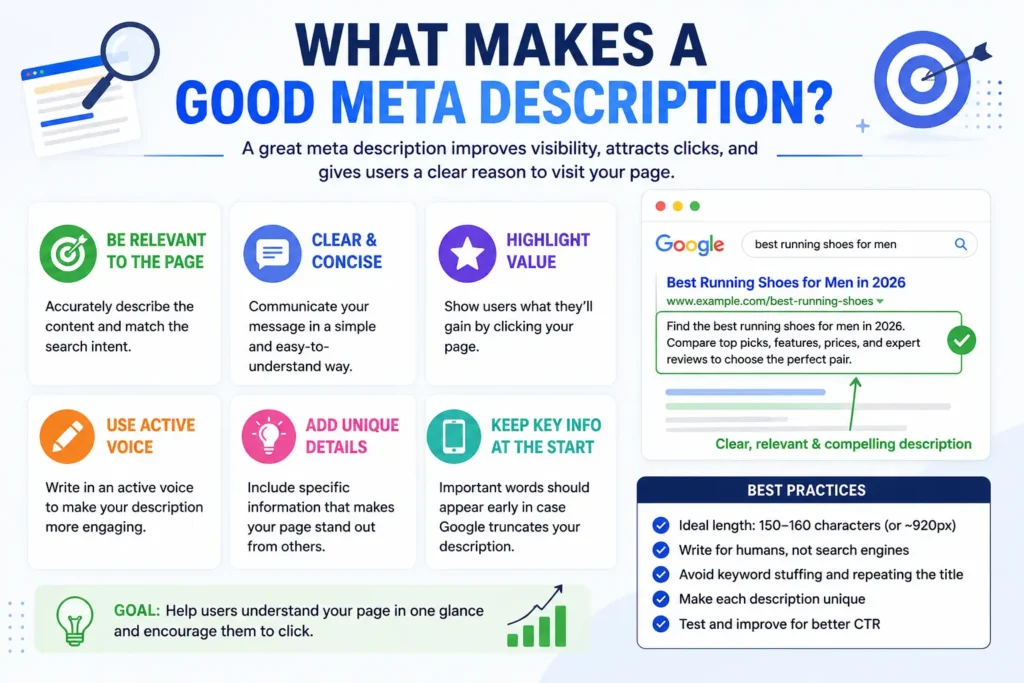
What makes a good meta description?
Before looking at the examples, it helps to understand what they are designed to accomplish.
A useful meta description should quickly answer three questions:
What is this page about?
The reader should understand the page’s topic immediately.
What will I get from clicking?
The wording should communicate a useful outcome, resource, product, answer, or next step.
Why should I choose this result?
A specific benefit or differentiating detail can make the result more appealing without resorting to exaggerated claims.
There is no universal character count that guarantees perfect display because search snippets can vary by device, query, and context. Instead of obsessing over an exact limit, prioritize concise, accurate copy that represents the page well.
25 Meta Description Examples Worth Studying
1. Blog post example
Meta description:
Learn how to write effective meta descriptions with practical examples, proven formatting ideas, and simple tips for improving your search listings.
Why it works: It tells the reader exactly what they will find and focuses on practical value.
2. SEO guide example
Meta description:
Explore essential SEO strategies for improving your website visibility, attracting relevant visitors, and creating content that better matches search intent.
Why it works: It combines the subject, audience benefit, and outcome without overpromising rankings.
3. Homepage meta description example
Meta description:
Rapid Tool Plus provides practical online generators and useful digital tools for SEO, content creation, social media, and everyday productivity.
Why it works: A homepage description should explain what the website is and what visitors can do there.
4. SaaS homepage example
Meta description:
Plan projects, organize team tasks, and monitor progress from one simple workspace built for growing businesses and remote teams.
Why it works: It focuses on what the software does rather than relying on vague marketing language.
5. Product meta description example
Meta description:
Shop a lightweight stainless steel water bottle designed for everyday use, with a leak-resistant lid and an easy-to-carry design.
Why it works: It highlights useful product attributes and helps set expectations before the click.
6. Shopify meta description example
Meta description:
Discover comfortable everyday sneakers in multiple styles and sizes. Browse the latest collection and find a pair that fits your routine.
Why it works: Shopify product pages benefit from clear product information, descriptive language, and a natural shopping-oriented message.
7. Ecommerce category example
Meta description:
Browse women’s running shoes for daily training, road running, and long-distance sessions. Compare styles, cushioning, and fit options.
Why it works: Category pages need broader language than an individual product page.
8. Local business example
Meta description:
Find professional plumbing services for repairs, installations, and maintenance. Serving homeowners with practical solutions for everyday plumbing problems.
Why it works: It identifies the service and the audience without making unsupported claims.
9. Service page example
Meta description:
Explore technical SEO services covering site audits, indexing issues, on-page improvements, and practical recommendations for stronger website performance.
Why it works: A service-page description should explain what is included and help the searcher decide whether the page is relevant.
10. How-to article example
Meta description:
Learn how to create a meta description step by step, from identifying search intent to writing concise copy that accurately reflects your page.
Why it works: It mirrors the user’s task and explains what the article will teach.
11. Tutorial example
Meta description:
Follow this beginner-friendly guide to keyword research, including search intent, keyword ideas, evaluation methods, and practical examples.
Why it works: It establishes the scope of the tutorial without unnecessary wording.
12. Comparison page example
Meta description:
Compare popular email marketing platforms by features, pricing considerations, automation options, and ease of use to find the right fit.
Why it works: Searchers immediately understand that the page helps them compare options.
13. “Best tools” article example
Meta description:
Compare the best SEO tools for keyword research, site analysis, content planning, and reporting, with practical guidance for different needs.
Why it works: It combines the list intent with clear selection criteria.
14. Statistics page example
Meta description:
Explore current social media statistics, platform trends, audience data, and useful figures for marketers, creators, and business owners.
Why it works: It identifies the information type and intended audience.
15. Educational resource example
Meta description:
Understand how compound interest works with simple explanations, formulas, and worked examples designed to make the calculation easier to follow.
Why it works: It promises understanding and practical examples rather than simply repeating the topic.
16. Calculator page example
Meta description:
Calculate percentages quickly with a simple online calculator and follow the steps behind the result to better understand the calculation.
Why it works: The description communicates both the utility and the educational value of the page.
17. Recipe page example
Meta description:
Make an easy chicken pasta dinner with simple ingredients, clear cooking steps, and practical substitutions for a flexible weeknight meal.
Why it works: It tells the searcher what they will make and emphasizes convenience.
18. Travel guide example
Meta description:
Plan a weekend in London with ideas for sightseeing, food, neighborhoods, transport, and practical tips for first-time visitors.
Why it works: It previews the useful information available on the page.
19. Financial education example
Meta description:
Learn the basics of budgeting, including how to track expenses, set realistic spending limits, and build a plan around your financial goals.
Why it works: The wording is educational and avoids making financial promises.
20. Real estate example
Meta description:
Explore practical home-buying considerations, from preparing your budget and comparing properties to understanding key costs before making an offer.
Why it works: It summarizes the buyer journey instead of using generic sales copy.
21. B2B software example
Meta description:
Compare project management software features for teams, including task planning, collaboration, reporting, automation, and workflow management.
Why it works: B2B searchers often want feature-level information before visiting the page.
22. News-style article example
Meta description:
Read the latest developments, key background information, and important context surrounding the topic in one concise overview.
Why it works: It describes the value of the page without inventing facts or using exaggerated language.
23. FAQ page example
Meta description:
Get clear answers to common questions about website SEO, including indexing, keywords, meta descriptions, internal links, and technical issues.
Why it works: The description matches question-based search intent and previews the coverage.
24. Portfolio or personal brand example
Meta description:
Explore selected design projects, creative work, and professional experience across branding, web design, and digital products.
Why it works: It gives visitors a quick understanding of what the portfolio contains.
25. Conversion-focused example
Meta description:
Discover practical ways to improve your website pages with clearer messaging, stronger calls to action, and content aligned with user intent.
Why it works: It focuses on useful outcomes without promising a specific conversion increase.
What these meta description examples have in common
Although the examples cover very different industries, several patterns appear repeatedly.
They match the page
A description should accurately summarize the page it represents. A compelling sentence is not useful if the landing page does not deliver what it suggests.
Google’s current guidance emphasizes creating helpful, reliable, people-first content rather than content created primarily to manipulate search visibility.
They match search intent
Someone searching for a product expects product information. Someone searching for a tutorial expects instructions. Someone comparing tools expects differences and selection guidance.
Your meta description should reflect that expectation instead of using the same promotional style for every page.
They lead with useful information
Compare these two approaches:
Weak:
“Welcome to our amazing website with the best solutions for everyone.”
Stronger:
“Compare project management tools by features, automation, collaboration, and reporting to find an option that fits your team.”
The second version provides actual information before asking for the click.
They use natural language
Keywords can be useful when they naturally describe the page, but repeating the same phrase several times rarely improves readability.
For example:
Awkward:
“Meta description example tips for meta description examples and meta descriptions.”
Natural:
“See practical meta description examples for blogs, products, homepages, and service pages.”
The second version communicates the topic clearly while still using relevant language.
How to write a better meta description from scratch
A simple process can make writing descriptions much easier.
Start with the page’s main purpose
Ask yourself what the visitor will actually find after clicking.
Is it:
- a guide?
- a product?
- a service?
- a category?
- a calculator?
- a comparison?
- a homepage?
- an informational resource?
Your answer determines the direction of the description.
Identify the searcher’s likely goal
Think about the reason behind the query.
For example, someone searching for “Shopify meta description example” may want to see a realistic example specifically for an ecommerce store.
Someone searching for “homepage meta description examples” is more likely to want ideas that explain a business or website clearly.
Lead with the most useful detail
Don’t hide the main point behind a generic introduction.
Instead of:
“Are you interested in learning more about…”
Try:
“Compare…”
“Learn…”
“Explore…”
“Find…”
“Calculate…”
“Shop…”
The right opening depends on the page.
Add one specific reason to click
The reason might be:
- practical examples
- product details
- comparison points
- step-by-step instructions
- downloadable resources
- useful calculations
- relevant service information
A specific benefit is usually more meaningful than generic words such as “amazing” or “ultimate.”
Before-and-after meta description examples
Sometimes the easiest way to improve your writing is to compare a weak version with a stronger one.
Example 1: SEO article
Before:
Learn all about SEO and get the best SEO tips in our complete guide.
After:
Learn practical SEO strategies for keyword research, content planning, technical improvements, and better search visibility.
The revised version tells the reader what the article actually covers.
Example 2: Product page
Before:
Buy our amazing premium backpack today at the best price.
After:
Explore a lightweight everyday backpack with multiple compartments, padded laptop storage, and a compact travel-friendly design.
The second version gives useful product context instead of relying on vague promotional wording.
Example 3: Service page
Before:
We provide excellent SEO services to help your business grow online.
After:
Explore SEO services covering technical audits, on-page improvements, keyword research, and practical site recommendations.
The second version is more specific and easier to evaluate.
How a meta description differs by page type
A common mistake is writing every description in the same way.
| Page Type | What to Emphasize |
| Homepage | What the business or website offers |
| Blog post | Main answer, topic, and useful takeaway |
| Product page | Product features, use, and key details |
| Category page | Product or service range |
| Service page | Services covered and relevant problems |
| Comparison page | Options, features, and decision criteria |
| Calculator | What can be calculated and how it helps |
| Local page | Service, location, and relevant offering |
| Tutorial | Task, process, and expected learning outcome |
This approach helps each description reflect the actual role of the page.
A simple meta description formula
There is no single formula that works for every website, but this framework is a useful starting point:
Primary topic + specific value + useful detail + natural action
For example:
Keyword/topic: Meta descriptions
Value: Practical examples
Detail: Blogs, products, and homepages
Action: Explore the examples
Result:
Explore practical meta description examples for blogs, products, homepages, services, and ecommerce pages.
The formula is only a starting point. The final wording should always be adapted to the page.
What to avoid when writing descriptions
Some approaches make a description less useful even when the keywords are correct.
Don’t make promises the page cannot support
Avoid claims such as:
- guaranteed rankings
- guaranteed traffic
- guaranteed conversions
- instant SEO results
A description should accurately represent the page.
Don’t make every page sound identical
Using the same description across multiple URLs makes it harder for users to distinguish the pages.
Each important page should have wording that reflects its specific content.
Don’t treat character count as the only goal
Search snippets can be rewritten or displayed differently depending on the query and device. Google’s documentation notes that the snippet is primarily based on page content, which means your visible page copy matters too.
Don’t write only for keywords
Google’s current guidance encourages useful, original, people-first content rather than content created simply to target search systems.
Your description should make sense to a person first.
Creating descriptions faster with Rapid Tool Plus
When you already know what a page is about but need help turning that information into a concise search-result description, Rapid Tool Plus provides a Meta description generator that can help create starting ideas for your page copy. An AI meta description generator can also help you explore different wording, while a Free meta description generator can be useful when you want a simple way to draft and refine descriptions. You can review the generated wording, adjust it to match the actual page content and search intent, and use the final version as part of your SEO workflow. Visit Rapid Tool Plus to explore its collection of practical online tools.
A practical checklist before publishing
Before adding a meta description to a page, check whether it:
- Accurately represents the page.
- Matches the likely search intent.
- Uses natural language.
- Communicates a clear benefit or purpose.
- Avoids unnecessary repetition.
- Gives the searcher a useful reason to click.
- Is different from descriptions on other important pages.
- Does not make unsupported promises.
- Fits the actual content users will see after clicking.
This checklist is more useful than trying to force every description into one rigid formula.
Final takeaway
The best meta description example is not necessarily the cleverest or most persuasive sentence. It is the one that accurately tells the right searcher what they will find, why the page is relevant, and what useful value they can expect from visiting it.
Use the 25 examples above as patterns rather than sentences to copy. Adapt the wording to your page type, search intent, audience, and actual content. That approach produces descriptions that are more useful to readers and more consistent with Google’s people-first search guidance.
Want to Explore More Meta Description Tools?
Looking for more ways to improve your meta descriptions? Read our 10 Best AI Meta Description Generators for SEO in 2026 to explore popular tools, their features, and which type may suit your SEO needs.
FAQs
What is a good meta description example?
A good example clearly explains the page and gives the searcher a reason to visit. For a guide, it might summarize the topic and mention practical examples or steps the reader will find.
How long should a meta description be?
There is no guaranteed character length that ensures the exact text will always appear in Search. Google can generate or adjust snippets based on the query and page content, so clarity and relevance matter more than hitting an exact character count.
Should a meta description contain the target keyword?
A relevant keyword can be included when it naturally describes the page, but keyword repetition is unnecessary. Write for the searcher’s understanding first.
What is a homepage meta description?
A homepage meta description briefly explains what the website or business offers. It should usually focus on the site’s main purpose rather than describe one specific page or product.
Should every page have a unique meta description?
For important pages, unique descriptions can help searchers distinguish one result from another. The wording should reflect each page’s specific content and purpose.
Can Google rewrite my meta description?
Yes. Google may use text from the page itself to create the displayed snippet rather than showing the exact HTML meta description. Google’s current documentation identifies page content as the primary source for snippets.