Writing a useful best Ai meta description for one page is easy enough. Writing unique, relevant descriptions for dozens, hundreds, or thousands of pages is a different problem. That is where an AI meta description generator can save time.
These tools can turn a page topic, title, keyword, or content summary into several description drafts. The strongest ones do more than produce text: they help you work within practical length targets, adapt the wording to the page, and fit metadata into an existing SEO workflow.
For 2026, there is also an important distinction to understand. Google does not always display the exact meta description you provide. Google says snippets are primarily generated from page content and may use the meta description when it provides a better description of the page. Google also recommends making descriptions unique, relevant, and useful rather than filling them with keyword strings.
With that in mind, here are 10 AI-powered options worth considering, along with the type of user each tool suits best.
10 AI Meta Description Generators Compared
| Tool | Best for | Standout use |
| Rapid Tool Plus | Bloggers and small websites | Free, quick description generation |
| Ahrefs | SEO professionals | Metadata inside a broader SEO ecosystem |
| Jasper | Large content teams | High-volume, brand-controlled workflows |
| Copy.ai | Marketing teams | Automation and content operations |
| Surfer | SEO content marketers | Metadata inside content optimization |
| Rytr | Freelancers and multilingual users | Tone and language flexibility |
| Scalenut | Content teams | AI writing and SEO utilities together |
| Quattr | SEO and search-visibility teams | AI metadata plus broader SEO tooling |
| NEURONwriter | Content optimization | Meta titles and descriptions inside the editor |
| Semrush | Established SEO teams | Search-intent, keyword, and content workflows |
The right choice depends on whether you need a simple writing tool, a free online tool, or a larger SaaS SEO platform.
1. Rapid Tool Plus
Rapid Tool Plus is a practical choice for users who want a free meta description generator without committing to a larger SEO platform.Its current generator takes a page title or topic, primary keyword, optional secondary keywords, an optional call to action, and a selected tone. It generates three variants and provides a live character ruler with 155- and 160-character targets. The available tones include informative, persuasive, friendly, and professional.
That makes it useful for everyday SEO work such as blog posts, service pages, product pages, category pages, and landing pages.One particularly useful workflow is to create several alternatives, compare how each one communicates the page’s value, and then make a final manual edit before publishing.
Best for: Website owners who want a straightforward, free online generator.
2. Ahrefs
Ahrefs offers a dedicated free AI Meta Description Generator. Its current tool can generate three variants from a description of the page and supports different writing tones.
The bigger attraction is the surrounding SEO ecosystem. If you already use Ahrefs for keywords, content research, and competitor analysis, generating a page description inside the same broader workflow can be convenient.This is particularly helpful when your metadata needs to reflect actual search intent rather than simply repeat the page title.
Best for: SEO professionals already working with Ahrefs.
3. Jasper
Jasper is aimed more at teams managing content at scale than people writing one description at a time.Its current Meta Title and Description workflow is designed for larger page inventories. Jasper describes using page content, keyword targets, brand voice, style guidance, and other context to create descriptions across many URLs. Its workflow can also run optimization after generation.
That makes Jasper especially interesting for enterprise websites, publishers, ecommerce operations, and agencies managing large batches of metadata.The major benefit is consistency. A team can establish a brand voice and formatting rules rather than generating isolated descriptions with different styles.
Best for: High-volume SEO and content operations.
4. Copy.ai
Copy.ai provides a free meta description generator and a broader set of AI-powered content workflows. Its current tool focuses on creating concise descriptions from page context and keywords, then allowing the user to refine the result.Copy.ai is also built around scalable workflows. Its SEO content-brief workflow, for example, can use search results to produce questions, titles, outlines, slugs, keywords, and meta descriptions.
That makes it more than a simple copy generator. It can fit into a content production system where metadata is one step among several.
Best for: Marketing teams and businesses building repeatable content workflows.
5. Surfer
Surfer focuses heavily on content optimization, so its metadata features make the most sense when used as part of a larger SEO process.
Its current documentation describes AI-generated meta titles and descriptions inside Content Editor and Surfer AI workflows. The purpose is to create metadata that matches the content and communicates what the page contains.The advantage is workflow integration. Instead of finishing an article and then moving to an unrelated tool for metadata, you can handle those steps together.
Best for: Content marketers who already use Surfer for on-page optimization.
6. Rytr
Rytr is a strong option when tone and language flexibility matter.Its current AI Meta Description Generator lets users select a language, choose from preset or custom tones, add information about the page, and generate metadata. Rytr says its meta-description workflow supports more than 30 languages and more than 20 tones or customizable options.
That can be useful for agencies and businesses publishing content across multiple markets. A description for a formal B2B service page may need a different tone from a consumer-facing product page, even when the underlying SEO topic is similar.
Best for: Freelancers, agencies, and multilingual content workflows.
7. Scalenut
Scalenut has a dedicated free meta description generator for blog posts and other pages. Its current workflow asks users for a topic, context, and focus keyword before generating a description.The platform also includes other content and SEO utilities, such as product-description generation, blog ideas, content optimization, and technical tools.
This makes it useful for users who prefer having multiple content tasks in one platform instead of switching between separate tools.
Best for: Content teams looking for an AI writing and SEO toolkit.
8. Quattr
Quattr provides a free AI Meta Description Generator that allows users to enter a page title or topic and optionally add information about the page content. The platform also supports broader SEO and search-visibility workflows.One practical advantage is the ability to keep metadata connected to broader search strategy rather than treating it as a standalone writing exercise.
Quattr is particularly relevant for teams interested in SEO alongside newer concepts such as AEO and GEO, where content visibility can extend beyond traditional blue-link results.
Best for: SEO teams working across traditional and AI-driven search visibility.
9. NEURONwriter
NEURONwriter integrates metadata directly into its content-editing environment. Its current documentation explains that meta titles and descriptions can be entered and optimized from the title area, with AI generation available as part of the workflow.
That makes sense for writers who want their title, description, and article content to stay connected during the optimization process.It is less about creating a single standalone snippet and more about managing metadata as part of the page-writing experience.
Best for: Writers and SEOs who optimize content within an editor.
10. Semrush
Semrush is worth considering when metadata generation is only one part of a much larger SEO workflow.Its current SEO Brief Generator can use search-intent and competitor information to create briefs containing keywords, titles, meta descriptions, and content outlines. Semrush also provides tools for keyword research, topic planning, content optimization, and AI-assisted writing.
For an established SEO team, the value is less about having a separate “meta description generator” and more about connecting the description to keyword research and content strategy.
Best for: Professional SEO teams and agencies using a full SEO platform.
Which type of meta description generator should you choose?
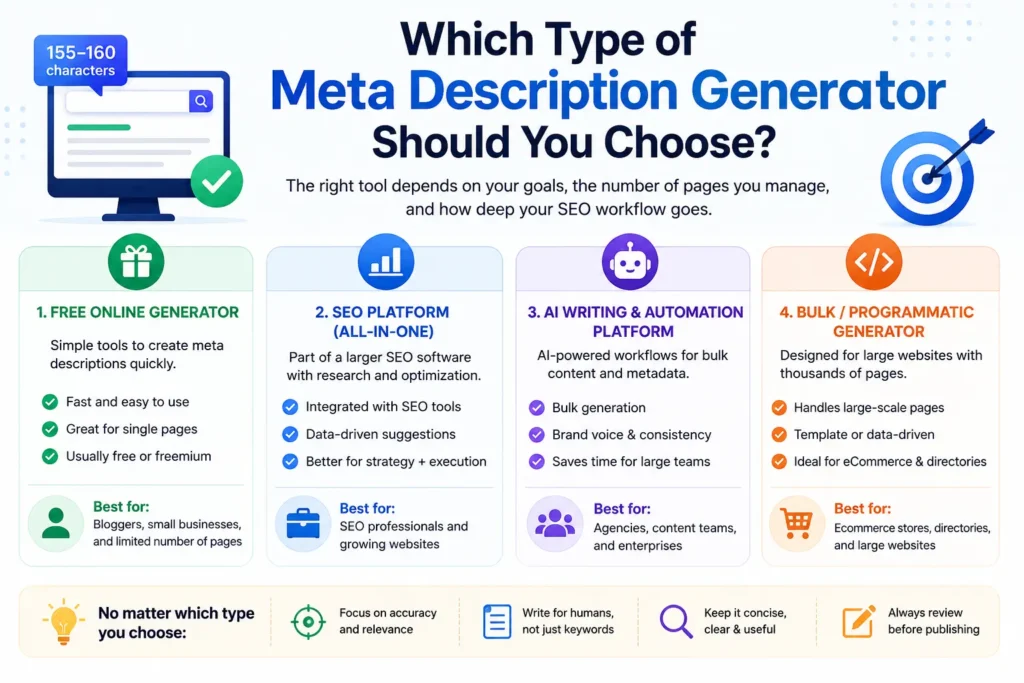
There is a clear difference between a lightweight generator and a full SEO platform.
When a free online generator is enough
A meta description generator free online is usually sufficient when you are managing a blog, local business site, small ecommerce store, or a limited number of URLs.The main job is simple: give the tool accurate context, generate several options, check the wording, and publish the strongest version.For that type of workflow, paying for an entire SEO suite may add complexity you do not need.
When a full SEO platform makes more sense
Larger teams may need keyword research, competitive analysis, content briefs, optimization, and metadata in one place.That is where tools such as Ahrefs, Semrush, Surfer, Jasper, and Quattro become more attractive. Their current workflows connect metadata generation with other SEO or content functions rather than treating it as a standalone task.
When automation matters most
A bulk meta tag generator becomes more valuable as the number of pages increases.Consider an ecommerce store with hundreds of category and product URLs. Writing every description manually may take significant time. Programmatic or AI-assisted generation can help create a starting point, provided each output is still relevant to the actual page.Google explicitly says programmatic descriptions can be appropriate for large database-driven sites, as long as the resulting descriptions are human-readable, diverse, and page-specific.
What should a good AI meta description contain?
A useful description should help the searcher understand what the page offers.
Think in terms of three questions:
What is this page about?
The description should make the subject clear.
What will the visitor get?
Mention the useful information, comparison, product details, solution, or outcome actually present on the page.
Why would this result be relevant to this search?
Use the main topic or keyword naturally when it makes sense.
For example, instead of writing:
SEO meta description generator free tool for SEO meta descriptions and SEO descriptions online.
A more natural description would be:
Create concise meta descriptions from your page topic and keyword, review several drafts, and refine the wording before publishing.
The second version focuses on usefulness rather than repeating the same phrase.
Google specifically warns against descriptions made up of long keyword strings and recommends concise, relevant descriptions that accurately represent individual pages.
Does the meta description affect Google rankings?
This is an area where SEO advice is often overstated.Google says snippets are primarily generated from a page’s actual content. A meta description may be used when it provides a better description, but Google can also show different text depending on the search query.
So the practical goal should not be “put the keyword here to increase rankings.”
A better goal is:
Make the search result accurately explain the page and give the right searcher a useful reason to click.That is also why a strong SEO meta description generator should be treated as a drafting assistant, not an automatic ranking system.
Should you generate descriptions from a URL?
A meta description generator from URL can be useful when optimizing existing pages because the page itself can provide contextual input.
But URL-based generation still requires editorial review.
Before publishing, verify that the generated description:
- Matches the current content.
- Represents the main purpose of the page.
- Does not promise information the page does not contain.
- Is meaningfully different from other pages.
- Read naturally.
- Does not become a string of repeated keywords.
A generator can process the input. It cannot replace the person who knows what the page actually delivers.
Meta description length: don’t obsess over one number
You will often see recommendations such as 150–160 characters. Those are useful working targets for writing concise descriptions, and several current tools are built around similar practical limits.However, Google says there is no fixed maximum length for the meta description itself. The search-result snippet is truncated as needed based on the device width and other circumstances.The right approach is therefore to keep the description concise without cutting useful information merely to hit an arbitrary character count.
AI-generated metadata still needs human review
AI is good at producing variations quickly. It can also make mistakes.
A generated description may:
- Introduce a claim that is not on the page.
- Use generic marketing language.
- Repeat a keyword awkwardly.
- Describe the topic too broadly.
- Miss an important page-specific detail.
This is especially relevant as AI-assisted content production expands. Google states that generative AI can be useful for research and structure, but producing large amounts of content without adding meaningful value may not align with Google’s search quality guidelines. The same editorial principle applies here: use automation to reduce repetitive work, but keep accuracy and page-specific relevance under human control.
A better workflow for using any AI meta description generator
Start with the page, not the tool.Identify the search intent, the main topic, the audience, and the most important value the page provides. Then give that information to your chosen generator.Generate several options rather than taking the first result automatically.After that, remove anything vague or unsupported. Check the wording against the actual page, make the sentence easy to understand, and ensure the description is unique enough to distinguish that URL from similar pages.
Finally, inspect the result after publishing in Google Search Console and compare how your pages perform over time.That workflow is much more reliable than expecting an automatic meta title and description generator to solve every SEO decision for you.
A simple example
Imagine you have a page targeting:
Best CRM software for small businesses
A weak AI output might focus heavily on the keyword:
Best CRM software for small businesses. Find the best CRM tools and best CRM software for small business owners.
A better version would communicate the actual content:
Compare CRM software for small businesses by features, pricing, ease of use, and team needs to narrow down your options.
The second description gives the searcher a clearer preview of the page.The point is not to create the most keyword-heavy snippet. The point is to create the most useful summary.
Final Thoughts
The best meta description generator depends on the scale of your SEO work.For a simple and free workflow, Rapid Tool Plus is a practical starting point. Ahrefs and Semrush are better fits for established SEO processes. Jasper and Copy.ai stand out when automation and high-volume content operations matter. Surfer, Rytr, Scalenut, Quattr, and NEURONwriter are useful when metadata generation is part of a broader content or optimization workflow.
The tool is only half of the equation, though. The best result comes from combining automation with accurate page context, human review, and descriptions that genuinely help searchers understand what they will find.
Want to Understand Meta Descriptions Better?
Before choosing an AI meta description generator, it helps to understand what a meta description is and how it fits into SEO. Read What Is a Meta Description? Complete SEO Guide for Beginners to learn the basics, best practices, and how to write effective meta descriptions.
FAQs
What is a meta description generator?
A meta description generator creates draft descriptions for webpages based on inputs such as a page topic, title, keywords, or page content. AI versions can produce multiple variations quickly.
Is an AI meta description generator free?
Some are free, while others are part of paid SEO or content platforms. Ahrefs, Rapid Tool Plus, Scalenut, and Quattr currently offer free generator options or free-access tools, although broader platform features may vary.
Can AI generate a meta description from a URL?
Some workflows can use page content or URL-based context. However, the output should still be checked against the live page because an automated draft may not capture the most important information accurately.
Does Google always show my meta description?
No. Google primarily creates snippets from page content and may use the meta description when it provides a better summary. Different searches can also result in different snippets.
Should I put my main keyword in the meta description?
Use it naturally when it helps explain the page, but do not repeat it unnecessarily. Google specifically recommends useful, descriptive text rather than keyword strings.
Is a 160-character meta description required?
No. Google does not define a fixed maximum length for the meta description. Search snippets are truncated according to the circumstances, so concise writing is more important than chasing one exact character limit.