
A tip calculator is a simple way to work out gratuity without doing percentage math in your head. It can help you calculate a tip on a restaurant bill, check the final amount, or divide a bill between several people.
For example, if your restaurant bill is $80 and you want to leave a 20% tip, the tip is $16 and your total before any additional charges is $96.
Although the math is straightforward, questions often come up when a bill includes tax, an automatic gratuity, discounts, or multiple diners. This guide explains the calculation step by step, gives practical examples, and covers common questions about tipping in the United States.
What Is a Tip Calculator?
A tip calculator is a mathematical tool that calculates a gratuity amount from a bill and a selected percentage.
The basic formula is:
Tip = Bill Amount × Tip Percentage ÷ 100
To find the final amount:
Total = Bill Amount + Tip
For example, for a $65 bill and a 20% tip:
$65 × 20 ÷ 100 = $13
The tip is $13, so:
$65 + $13 = $78
A calculator simply performs this calculation quickly and accurately.
Many modern tip calculators also support bill splitting, optional tax calculations, and different tip percentages. These features are useful when several people are paying together or when you want to compare different tipping amounts.
How to Calculate a Tip
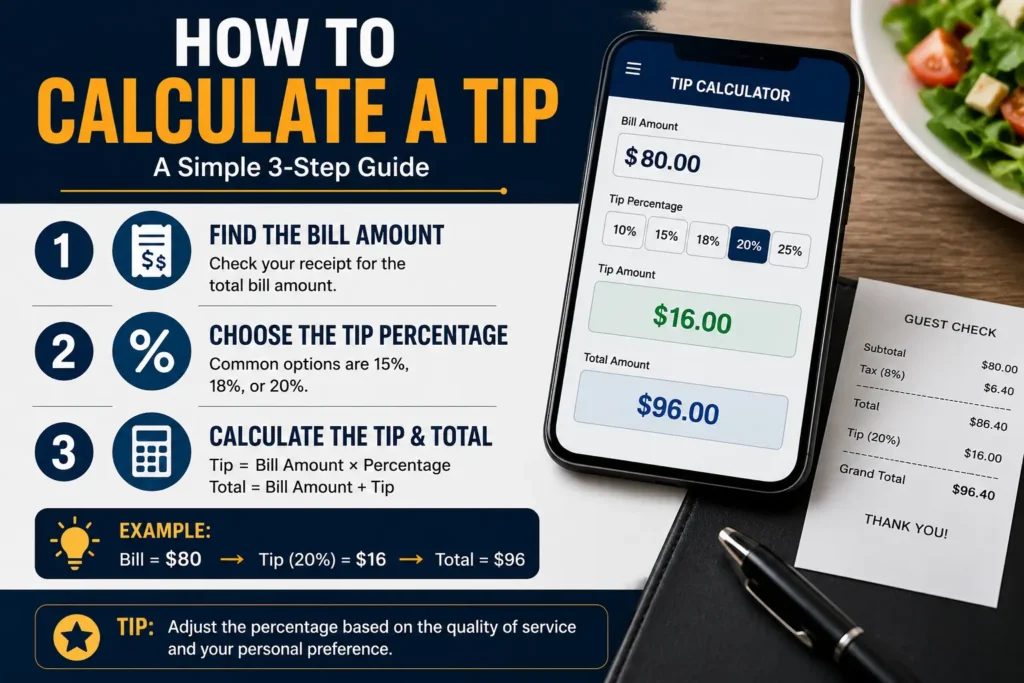
You do not need a special tool to understand the calculation. Follow these three steps.
Step 1: Find the bill amount
Look at the receipt and identify the amount you want to use for the tip calculation. This may be the food and beverage subtotal or another amount depending on the situation and your tipping preference.
Step 2: Choose the tip percentage
Enter a percentage such as 15%, 18%, or 20%.
There is no universal percentage that applies to every situation. Tipping expectations vary by type of service and circumstances. For restaurant wait service, Emily Post’s general etiquette guidance gives 15–20% of the pre-tax amount as a traditional guideline.
Step 3: Calculate the amount
Suppose the bill is $90 and you choose 18%:
$90 × 0.18 = $16.20
Your tip is $16.20.
The total is:
$90 + $16.20 = $106.20
Tip Calculator Examples
Understanding a few examples makes the formula easier to remember.
| Bill | Tip | Tip Amount | Total |
| $40 | 15% | $6.00 | $46.00 |
| $50 | 18% | $9.00 | $59.00 |
| $75 | 20% | $15.00 | $90.00 |
| $100 | 25% | $25.00 | $125.00 |
| $125 | 20% | $25.00 | $150.00 |
These examples show the mathematics only. The percentage you choose depends on the service, circumstances, and applicable tipping customs.
How to Calculate a 15%, 18%, or 20% Tip
Common percentages can be calculated quickly without a calculator.
15% tip
Calculate 10% and 5%, then add them.
For a $60 bill:
10% = $6
5% = $3
15% = $9
18% tip
Calculate 20% and subtract 2%.
For a $60 bill:
20% = $12
2% = $1.20
18% = $10.80
20% tip
Calculate 10% and double it.
For a $60 bill:
10% = $6
20% = $12
These shortcuts are useful when you are paying at a restaurant and need a quick estimate.
Should You Calculate a Tip Before or After Tax?
This is one of the most common tipping questions.
There is no single rule that everyone follows. Some people calculate the percentage on the pre-tax subtotal, while others choose to tip on the tax-inclusive amount. Emily Post’s restaurant guideline uses the pre-tax amount for its 15–20% recommendation.
Suppose your receipt shows:
- Food and drinks: $100
- Sales tax: $8
- Tip: 20%
Using the pre-tax subtotal:
$100 × 20% = $20
Your final amount would be:
$100 + $8 + $20 = $128
The important point is to understand which amount you are using before applying the percentage.
What About Automatic Gratuity or Service Charges?
Always check the receipt for a service charge before adding another tip.
A restaurant may add an automatic charge, particularly for larger groups. That charge may not be the same as a voluntary tip.
The IRS distinguishes voluntary tips from mandatory service charges for federal tax purposes. A payment generally considered a tip involves customer discretion, while a mandatory charge imposed by the business can be treated as a service charge instead.
For example, imagine a receipt includes an 18% automatic gratuity. Before adding another 18% or 20%, check what the charge represents.
This simple step can prevent accidentally paying gratuity twice.
How to Split a Restaurant Bill
A tip calculator can be especially useful when you are dining with friends or family.
Suppose:
- Bill = $160
- Tip = 20%
- Number of people = 4
First calculate the tip:
$160 × 0.20 = $32
Then calculate the total:
$160 + $32 = $192
Finally, divide the total:
$192 ÷ 4 = $48
Each person would pay $48 if the bill is divided equally.
Modern calculator tools commonly combine the tip, total, and per-person calculation in one result.
What If Everyone Ordered Different Amounts?
An equal split is convenient, but it is not always fair.
For example, one person may have ordered a $20 meal while another ordered a $60 meal. Dividing the entire bill equally would make both people pay the same amount despite different orders.
A better approach can be to calculate each person’s portion first and then apply the chosen tip percentage to those individual amounts.
Some bill-splitting tools support more detailed calculations, but you can also work it out manually with the same percentage formula.
How Much Should You Tip?
A calculator can tell you how much a percentage produces, but it cannot determine the appropriate percentage for every situation.
For U.S. restaurant wait service, 15–20% is commonly referenced in tipping guidance, including Emily Post’s general restaurant recommendations. Different services can have different expectations, and tipping practices can also vary by location and circumstance.
For that reason, treat percentages as guidelines rather than a mandatory mathematical rule.
It is also useful to look at the receipt and payment screen before deciding what to enter. Some businesses clearly identify optional tips, service charges, or included gratuity.
Common Tip Calculator Mistakes
1. Forgetting about an automatic charge
Always read the receipt before adding a voluntary tip.
2. Applying the wrong percentage
A small percentage difference can become significant on a large bill.
For example, on a $250 bill:
- 15% = $37.50
- 20% = $50
- 25% = $62.50
3. Confusing the tip with the total
A 20% tip does not mean the final bill is 20% of the original bill.
It means the tip itself equals 20% of the calculation base. The bill and tip are then added together.
4. Rounding too early
For exact calculations, perform the percentage calculation first and round the final monetary result to cents.
5. Splitting the bill without checking the math
When several people are paying, decide whether the bill should be divided equally or based on individual orders.
How to Calculate a Tip Without a Calculator
You can estimate common tips mentally.
For a 10% tip, move the decimal one place to the left.
$72 → $7.20
For 20%, double the 10% figure.
$7.20 × 2 = $14.40
For 15%, add 5% to 10%.
10% of $72 = $7.20
5% of $72 = $3.60
15% = $10.80
These shortcuts are useful, but an online calculator is more convenient when you have a complicated bill, several diners, or an exact percentage.
Tip Calculator vs. Manual Calculation
Both methods use the same mathematical formula.
| Method | Best For | Main Advantage |
| Manual calculation | Simple bills | No tool needed |
| Tip calculator | Exact amounts | Faster and less mental math |
| Bill-split calculator | Group dining | Calculates individual shares |
| Calculator with tax options | More detailed receipts | Helps compare different totals |
The purpose of an online tool is convenience. It does not change the underlying mathematics.
More Free Calculators for Everyday Math
Tipping is only one example of everyday percentage-based math. Rapid Tool Plus provides a collection of free online calculator tools for different types of calculations. You can use the free online calculator for everyday math tasks and explore related tools such as a free tip calculator, free BMI calculator, free loan calculator, free math calculator, free percentage calculator, free ratio calculator, free average calculator, free square footage calculator, and other practical calculators. To explore the complete collection of tools available on the website, visit the Rapid Tool Plus homepage, which also provides services such as the Meta Description Generator, Keyword Generator, Tag Generator, Hashtag Generator, YouTube Title Generator, and Instagram Caption Generator.
This service section is intentionally relevant to the wider calculator topic rather than inserting unrelated calculator keywords into the article.
When a Tip Calculator Is Useful
A tip calculator can be helpful when:
- The bill contains decimals.
- You want to compare different percentages.
- Several people are splitting the check.
- You need to calculate the total quickly.
- You want to double-check mental math.
- You want to avoid accidentally overlooking the tip or service charge.
- You need a precise result before paying.
It can also be useful when a restaurant receipt contains several numbers and you want to verify what the final amount should be.
Final Takeaway
A tip calculator makes percentage math easier, especially when a bill includes decimals, tax, several diners, or different tipping options.
The basic formula is simple:
Tip = Bill × Tip Percentage ÷ 100
Then:
Total = Bill + Tip
When dining in the United States, remember that tipping expectations vary by service and situation. Check the receipt for automatic gratuity or service charges before adding anything, and decide whether you want to calculate the tip using the pre-tax or tax-inclusive amount.
For simple calculations, mental math works well. For larger bills or group payments, a calculator can save time and reduce mistakes.
Frequently Asked Questions
What is the easiest way to calculate a tip?
Multiply the bill amount by the tip percentage expressed as a decimal.
For a 20% tip:
Bill × 0.20 = Tip
Then add the tip to the bill to find the total.
How much is a 20% tip on $50?
A 20% tip on $50 is $10.
The bill plus tip is $60, before considering any tax or other charges not already included.
How much is a 15% tip on $100?
A 15% tip on $100 is $15, making the amount before other charges $115.
Should I tip on tax?
Practices differ. Emily Post’s general restaurant guidance calculates its 15–20% recommendation using the pre-tax amount.
What should I do when an automatic gratuity is already included?
Check the receipt carefully to determine what the charge represents. A mandatory service charge is not necessarily the same thing as a voluntary tip, and adding another amount may not be necessary.
Can I use a tip calculator for more than restaurants?
Yes. The same percentage calculation can be applied to many service situations where gratuity is appropriate. However, the appropriate tipping custom depends on the type of service and circumstances.