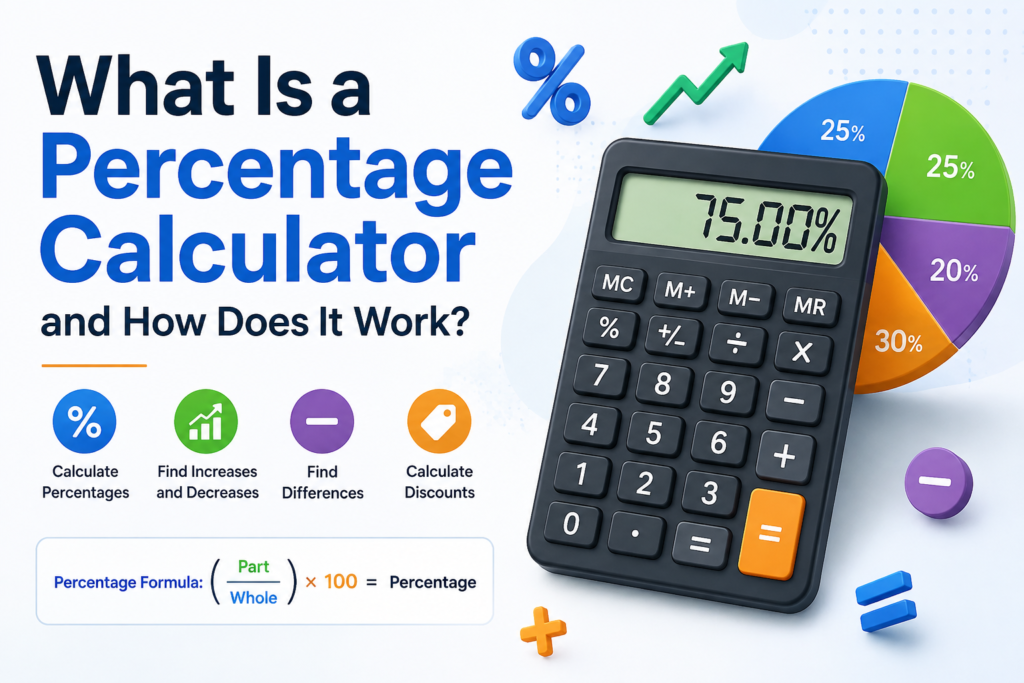
Percentages are everywhere: shopping discounts, exam scores, business growth, interest rates, budgets, taxes, and everyday comparisons. Yet a simple question such as “What is 18% of $250?” can become surprisingly easy to get wrong when you calculate it manually.
A percentage calculator removes that friction. It applies the appropriate percentage formula to your numbers and gives you a result quickly, while also helping you distinguish between related calculations such as percentage increase, percentage decrease, percentage difference, and percentage change.
What Is a Percentage?
A percentage is a way of expressing a number as a fraction of 100. The word “percent” literally means “per hundred.”
For example:
- 25% means 25 out of 100
- 50% means 50 out of 100
- 75% means 75 out of 100
- 100% represents the entire amount
You can write a percentage as a fraction or decimal:
- 25% = 25/100 = 0.25
- 60% = 60/100 = 0.60
- 7% = 7/100 = 0.07
This basic idea powers almost every percentage calculation.
What Is a Percentage Calculator?
A percentage calculator is an online tool that performs percentage-based calculations automatically. Instead of remembering every formula, you enter the values you know and let the calculator handle the arithmetic.
Depending on the tool, a percent calculator can answer questions such as:
- What percentage is one number of another?
- What is a percentage of a number?
- How much did a value increase?
- How much did a value decrease?
- What is the percentage difference between two values?
- How much is an item after a discount?
- What percentage of an amount is represented by a particular part?
These calculations use different formulas. That distinction matters because “20% of 500” is not the same calculation as “500 increased by 20%.”
How Does a Percentage Calculator Work?
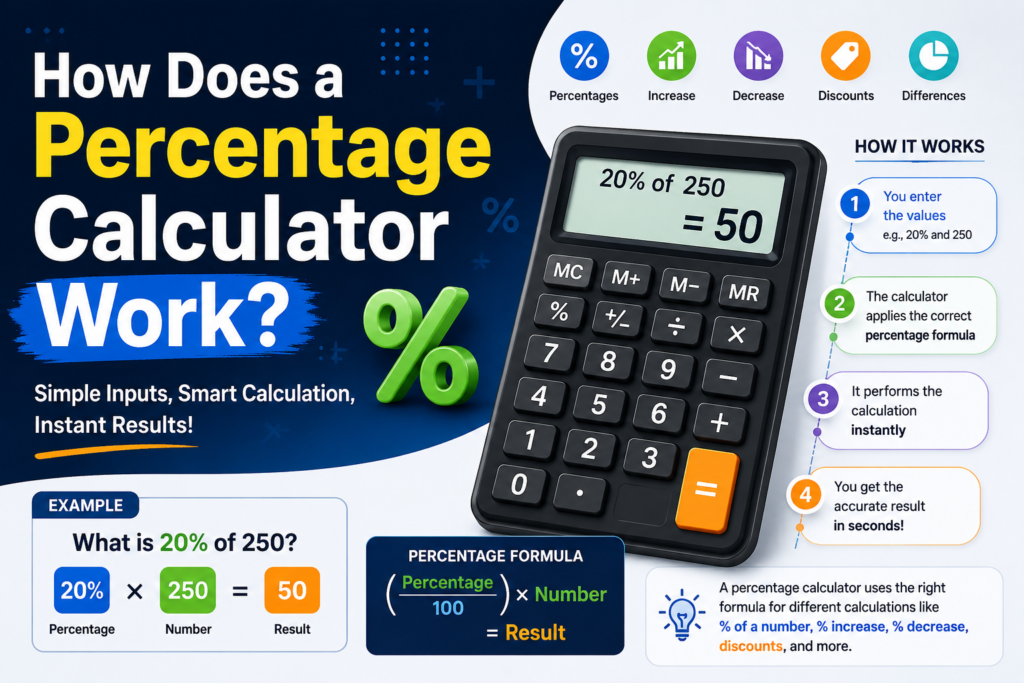
A percentage calculator takes your input values, identifies the type of calculation required, applies the appropriate percentage formula, and returns the result.
For instance, to find a percentage of a number, the calculator uses:
Percentage of a number = (Percentage ÷ 100) × Number
So, what is 15% of 200?
(15 ÷ 100) × 200 = 30
The answer is 30.
For percentage change, a different formula is needed:
Percentage Change = ((New Value − Old Value) ÷ Old Value) × 100
For example, a price rises from $80 to $92:
((92 − 80) ÷ 80) × 100 = 15%
That is a 15% increase.
A good calculator separates these scenarios rather than treating every percentage question as the same problem.
How to Calculate the Percentage of a Number
One of the most common questions is: How do you calculate the percentage of a number?
Use this formula:
Percentage = (Percent ÷ 100) × Number
Example
Suppose you want to find 4% of 5:
(4 ÷ 100) × 5 = 0.2
So, 4% of 5 is 0.2.
Another example:
25% of 400
= (25 ÷ 100) × 400
= 100
So 25% of 400 is 100.
This is useful for budgets, commissions, discounts, marks, tax calculations, and many other everyday situations.
How to Find What Percentage One Number Is of Another
To find what percentage one number represents out of another, use:
Percentage = (Part ÷ Whole) × 100
For example:
What percentage is 40 of 60?
= (40 ÷ 60) × 100
= 66.67%
Another common example:
What percent is 11 out of 15?
= (11 ÷ 15) × 100
= 73.33%
The key is identifying the correct part and whole before starting.
How to Calculate Percentage Increase
A percentage increase calculator is useful when a value has grown from an original amount to a new amount.
The formula is:
Percentage Increase = ((New Value − Original Value) ÷ Original Value) × 100
Example
A subscription price increases from $40 to $50.
Difference:
$50 − $40 = $10
Percentage increase:
($10 ÷ $40) × 100 = 25%
The price increased by 25%.
The same calculation can be used for revenue, traffic, salaries, sales, prices, production, or other measurable quantities.
How to Calculate Percent Change
The terms percent change calculator and percentage change calculator are commonly used for comparing an old value with a new one.
The standard formula is:
Percent Change = ((New Value − Old Value) ÷ Old Value) × 100
If the result is positive, the value increased. If it is negative, the value decreased.
For example, a website receives 8,000 visits in one month and 10,000 the next month:
((10,000 − 8,000) ÷ 8,000) × 100 = 25%
The traffic increased by 25%.
This is especially useful when tracking performance over time.
How to Calculate Percentage Decrease
A percentage decrease calculator or percent decrease calculator works similarly, but the new value is lower than the original value.
Formula:
Percentage Decrease = ((Original Value − New Value) ÷ Original Value) × 100
Example
A product drops from $200 to $150.
Difference:
$200 − $150 = $50
Percentage decrease:
($50 ÷ $200) × 100 = 25%
The price decreased by 25%.
You may also see this described as a percent reduction.
How to Calculate Percentage Difference
A percentage difference calculator is useful when comparing two values where neither one is necessarily considered the original or starting value.
The formula is:
Percentage Difference = |Value 1 − Value 2| ÷ ((Value 1 + Value 2) ÷ 2) × 100
For example, compare 50 and 60:
Difference:
|50 − 60| = 10
Average:
(50 + 60) ÷ 2 = 55
Percentage difference:
10 ÷ 55 × 100 = 18.18%
So the percentage difference is approximately 18.18%.
This differs from percentage change because percentage change normally uses a specific starting value as the reference point.
Percentage Off and Discounts
Shopping is another major reason people use a percentage calculator.
A percentage off calculator can determine the amount saved and the final price after a discount.
The basic formula is:
Discount Amount = Original Price × (Discount Percentage ÷ 100)
Then:
Sale Price = Original Price − Discount Amount
Example
A jacket costs $120 and is advertised at 25% off.
Discount:
$120 × 0.25 = $30
Sale price:
$120 − $30 = $90
So you save $30, and the discounted price is $90.
A discount percentage calculator is particularly useful when comparing sale prices without doing the arithmetic manually.
Percentage Error
A percentage error calculator is commonly used when comparing an experimental or measured value with an accepted or expected value.
A common formula is:
Percentage Error = |Experimental Value − Accepted Value| ÷ |Accepted Value| × 100
For example, suppose the accepted value is 50 and the measured value is 48.
|48 − 50| ÷ 50 × 100 = 4%
The percentage error is 4%.
The exact interpretation can depend on the field and measurement context, so technical or scientific work should follow the conventions applicable to that discipline.
Common Percentage Examples
Here are several quick examples that show how different percentage questions work.
| Question | Calculation | Answer |
| 16 out of 20 as a percentage | 16 ÷ 20 × 100 | 80% |
| 15 out of 20 as a percentage | 15 ÷ 20 × 100 | 75% |
| 12 out of 15 as a percentage | 12 ÷ 15 × 100 | 80% |
| 25 out of 30 as a percentage | 25 ÷ 30 × 100 | 83.33% |
| 8 out of 12 as a percentage | 8 ÷ 12 × 100 | 66.67% |
| 17/20 as a percent | 17 ÷ 20 × 100 | 85% |
| 3 out of 5 percentage | 3 ÷ 5 × 100 | 60% |
| 30 is 10% of what number? | 30 ÷ 0.10 | 300 |
These examples illustrate why identifying the question type before choosing a formula is important.
Percentage Formulas in Excel
You can also perform percentage calculations in Microsoft Excel or similar spreadsheet applications.
For example, if cell A2 contains the old value and B2 contains the new value, the Excel formula for percent change is:
=(B2-A2)/A2
Format the result as a percentage to display it accordingly.
For percentage of a number, you can use:
=A2*B2
when B2 contains a decimal percentage such as 15% or 0.15.
For example:
=200*15%
returns 30.
Excel is especially helpful when you need to perform the same calculation across hundreds or thousands of rows rather than calculating each value individually.
When Should You Use a Percentage Calculator?
A calculator is useful whenever the arithmetic is repetitive, time-sensitive, or easy to confuse.
Common use cases include:
- Shopping: finding discounts and sale prices
- School: converting scores into percentages
- Business: measuring sales or revenue growth
- Finance: comparing rates and changes
- Marketing: analyzing conversion or growth percentages
- Analytics: measuring changes between periods
- Everyday math: calculating portions and proportions
The advantage is not simply speed. It also reduces the chance of choosing the wrong formula or making a basic arithmetic mistake.
Common Percentage Calculation Mistakes
Even simple percentage problems can produce misleading answers when the inputs are handled incorrectly.
Confusing percentage of with percentage increase
“20% of 100” equals 20.
“100 increased by 20%” equals 120.
They are related, but they answer different questions.
Using the wrong reference value
Percentage change normally uses the old or original value as the denominator. Reversing the reference point can produce a different percentage.
Forgetting to convert a percent to a decimal
15% is 0.15, not 15 when multiplying by a number.
Mixing percentage difference with percentage change
Percentage difference uses the average of two values as the reference. Percentage change normally uses a defined starting value.
Rounding too early
If you round each intermediate step, your final answer may be slightly different from the exact result. When precision matters, keep more decimal places until the final calculation.
Rapid Tool Plus Percentage and Calculator Tools
Readers who want to put these calculations into practice can use Rapid Tool Plus, which provides online calculator tools for common mathematical tasks. Its free online calculator includes percentage calculations, discounts, tips, and basic arithmetic, making it useful when you need a quick result without installing an application.
The calculator service can help with a percentage calculator, discount calculator, tip calculator, basic calculator, percent increase, and percent decrease calculator calculations. Rapid Tool Plus also offers other calculator categories, including a BMI calculator and loan calculator, so readers can move from a single percentage problem to other everyday calculations from the same toolkit.
Final Takeaway
A percentage calculator is more than a shortcut for basic arithmetic. It helps you choose and apply the right calculation when you’re working with percentages, discounts, increases, decreases, differences, or changes.
The most important step is understanding what the question is actually asking. Once you know whether you need a percentage of a number, percentage change, percentage increase, percentage decrease, or percentage difference, the correct formula becomes much easier to apply.
For quick everyday calculations, an online tool can save time and reduce avoidable arithmetic errors. For important financial, tax, scientific, medical, or legal calculations, always verify the result against the rules and sources relevant to your situation.
Frequently Asked Questions
What is a percentage calculator?
A percentage calculator is a tool that solves percentage-related problems automatically. It can calculate a percentage of a number, percentage increase or decrease, percentage difference, discounts, and other related calculations.
How do you calculate the percentage of a number?
Multiply the number by the percentage expressed as a decimal.
Formula: (Percentage ÷ 100) × Number
For example, 20% of 150 is:
0.20 × 150 = 30
What percentage is 40 of 60?
Use:
(40 ÷ 60) × 100 = 66.67%
Therefore, 40 is 66.67% of 60.
How do you calculate percent change?
Use:
((New Value − Old Value) ÷ Old Value) × 100
A positive result indicates an increase, while a negative result indicates a decrease.
How do you find percent off?
First calculate the discount amount:
Original Price × Discount Percentage ÷ 100
Then subtract the discount from the original price.
For example, 20% off $50 is a $10 discount, giving a final price of $40.
How do you calculate percentage difference?
Subtract the two values, take the absolute difference, divide it by their average, and multiply by 100.
Percentage Difference = |A − B| ÷ ((A + B) ÷ 2) × 100
What percent is 11 out of 15?
11 ÷ 15 × 100 = 73.33%
So, 11 is approximately 73.33% of 15.
What is 4 percent of 5?
(4 ÷ 100) × 5 = 0.2
Therefore, 4% of 5 is 0.2.